

The most important points at a glance
- A balcony railing is essential for safety and privacy on the balcony and must meet both legal and technical requirements such as structural calculations, minimum height, and bar spacing.
- Metal railings, such as those offered by ELEO, impress with their durability, weather resistance, and modern appearance; they are ideal for personalizing your balcony.
- For DIY projects, ELEO recommends suitable assembly instructions and, if needed, supplies complete kits such as balcony railings and the necessary accessories for safe and professional installation.
Building your own balcony railing - inspiration & tips for your project
Do you want to equip your balcony with a new railing and are considering building it yourself? We explain what you need to consider legally beforehand, what costs you can expect – and when it's more advisable to choose a ready-made kit instead of building a railing yourself.
The railing: Safety and decoration for your balcony
A balcony is only truly complete with a suitable railing. A balcony railing's primary function is safety, preventing falls when accessing the balcony. It also serves as a privacy screen, shielding you from prying eyes.
Furthermore, a railing also serves a decorative purpose and significantly contributes to the overall aesthetic appeal of your house or apartment. While a wooden balcony railing creates a rustic and cozy atmosphere, a wrought-iron railing lends your balcony a romantic and elegant touch. Aluminum railings, especially when combined with glass elements, look very modern and minimalist.

Regardless of the material you choose for your balcony railing, there are a few important things you should consider before starting your DIY railing project. Please note.
Safety in your DIY balcony railing
Generally speaking, every balcony is subject to building permit requirements, which you must obtain in advance. Regardless of this, even if you are "only" a hobbyist, you can consider your balcony railing a DIY project and build and install it yourself. However, safety is paramount, as you are responsible for safety when building your own balcony railing. It's better to plan the project in detail than not enough – especially if you have children or pets in your household, who are particularly dependent on a stable and correctly installed balcony railing.

You should also inform yourself beforehand about the applicable building regulations, which vary from state to state. This way you can avoid legal problems from the outset.
Before your DIY balcony railing project can begin, check off the following points:
|
Structural Engineer |
Consult a structural engineer or architect |
|
State Building Code |
Check the applicable State Building Code |
|
Building Permit |
Obtain a building permit |
|
Building Inspection |
An official building inspection may be required |
The Height: How high must the balcony railing be?
There are clear regulations regarding railing height that you must observe. State building codes specify a minimum height of between 90 cm and 110 cm. The height is generally measured from the foundation slab. The exact specifications vary depending on the state. To be absolutely certain, consult the building code applicable to you or your state.
Spacing of the bars – for the protection of children
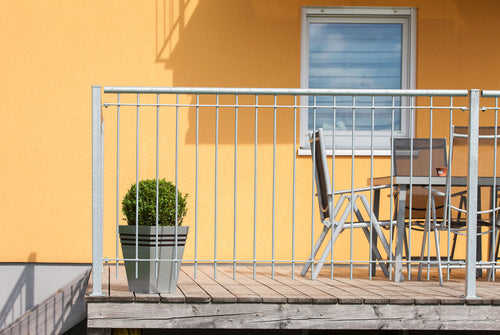
The spacing between the individual bars must also be considered. A maximum distance of 12 centimeters is specified to protect small children. Some state building codes also stipulate that horizontally arranged railings should be avoided, as these could be used by children as ladders and thus pose a danger.
Generally speaking: If a walkable area is more than one meter above ground level, a railing is required – for safety reasons. As a rule of thumb, you can remember that a railing is necessary for more than five steps. This also applies to terraces, loggias, entrance platforms, and even garage roofs, provided they are accessible.

The Statics – Weight and Loads Are Crucial
If you are building a balcony railing yourself, you must calculate the statics in addition to the height. These are determined by the weight of the railing itself and the projected load it will bear – for example, flower boxes, people leaning against it, and also the pressure from wind and storms.
To determine the correct values, it is best to consult a structural engineer who can calculate the stress according to DIN standard 1055. Based on this, the profile cross-sections of your railing and the post spacing can then be determined.
After you have calculated the height and statics of your future railing, you can consider the material. Rustic wood, modern stainless steel, or beautifully crafted wrought iron – the possibilities are endless, and each material has its own unique appeal. Building your own metal balcony railing – modern and clean Metal balcony railings have the major advantage of being virtually indestructible. Moisture, cold, and dirt have almost no effect on this resistant material. Furthermore, a metal railing looks very modern and fits perfectly with minimalist new buildings. Building a stainless steel railing or a metal balcony railing yourself requires some craftsmanship, as welding and cutting are necessary. For a simple and relatively inexpensive metal balcony railing, it's best to choose square tubing, which you can find in any well-stocked hardware store.
Pipes are suitable as handrails because their shape makes them ergonomic, and their rounded form also makes them ideal for hanging flower boxes later on.
The following video offers tips for building and, in particular, welding a stainless steel railing:
Build your own wooden balcony railing – a rustic classic
A wooden balcony railing is a timeless classic for balcony safety and impresses with its rustic charm. Wood is an uncomplicated building material, and even with minimal DIY skills, a simple balcony railing can be assembled from it.

First, the question of material selection arises. The following types of wood are well-suited because they are relatively resistant to weathering:
- Douglas fir
- Larch
- Beech
- Oak
At a specialist retailer, you can buy pre-cut components such as balcony boards, handrails, brackets, and decorative panels if you don't want a complete kit.
Proper protection is crucial for the weather resistance of your wooden railing. Impregnating stains and topcoats provide lasting protection for the wood.
The costs: What you need to consider when building your own railing
Building a balcony railing yourself is, firstly, a time-consuming project. Plan for several days to weeks before your balcony railing is fully functional and ready to adorn your balcony. Secondly, you should calculate the material costs beforehand. Depending on the size of your balcony and the choice of material, these can quickly add up to several hundred euros. A wooden balcony railing will be cheaper than one made of stainless steel or metal – at least if you don't want to build a railing from serviceberry or bog oak. Screws, nails, nuts, and other hardware will also need to be purchased, and possibly additional specialized tools. If you want to build your new railing more cost-effectively, a ready-made kit is certainly an option. While this largely eliminates the fun of the hands-on work, you can expect the costs to remain manageable and to be incurred only once.
Buy wrought iron balcony railings as a kit – customized and perfectly fitted
Especially if you want an elaborate wrought iron railing for your balcony, a ready-made kit is the ideal choice. Professional and specialized metal railing suppliers offer to manufacture the kits precisely to your specifications and deliver them directly to your home.

Even if you opt for a ready-made kit, you still have plenty of creative freedom. At ELEO Express, for example, you can freely configure the coating type, which complies with DIN standards, and specify the desired dimensions online, in addition to a wide variety of modern and delicately romantic balcony railings. This way, you get a custom railing that you can assemble yourself – and simultaneously avoid potentially unpredictable costs that can quickly arise with a DIY railing project.


