
Retrofitting a gate operator – explained step by step in a DIY project
The Essentials in Brief
- Retrofitting a gate operator is possible for most garden, courtyard, and driveway gates, provided the structural fabric, such as posts and hinges, is intact and the gate runs smoothly.
- Precise planning of the mounting points, correct adjustment of the end positions, and careful testing of the safety functions are more crucial to success than the mere installation time.
- With good preparation, the mechanical implementation succeeds reliably as a DIY project; gates from ELEO Express offer an ideal basis for automation thanks to their sturdy construction.
Opening a gate by hand often interrupts daily life at the most inconvenient moments: in the rain, strong winds, or when you are in a hurry. Anyone looking to retrofit a gate operator is therefore usually not seeking a technological gimmick, but a robust and reliable solution that noticeably increases everyday convenience. This guide provides a practical overview of the prerequisites that must be met, the types of operators available, and how a DIY project is structured – from the initial measuring to the final, safe test run.
Intro – Why a gate operator is worthwhile in everyday life
Automating a gate not only increases convenience but also enhances the security and value of a property. An electric operator closes the gate reproducibly and in a controlled manner, which prevents manual operating errors such as slamming it too hard or leaving it incompletely closed. In the long term, this protects the mechanics of the hinges and frame. Furthermore, modern systems can be supplemented with safety features such as obstacle detection or photocells, which protect people and vehicles. Last but not least, an automatically opening gate suggests presence and can thus act as a deterrent.
The key to success lies in understanding that this is an overall system: mechanics, control, power supply, and protective functions must harmonise. Anyone wanting to electrically retrofit a courtyard gate or electrically retrofit a garden gate should therefore start with a solid inventory: a stable structure, smooth running, and well-thought-out mounting points are the foundation for a long-lasting solution.
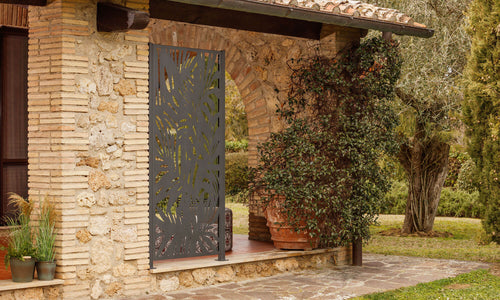
Pictured: Garden gate Lucca in powder-coated anthracite
Which gates are suitable for retrofitting
In principle, most private swing and sliding gates can be automated. However, suitability depends heavily on the gate type, the material, and the current condition. Ideal candidates are gates that can already be moved manually without significant effort and whose structure does not warp during weather fluctuations.
Retrofitting a gate operator on swing gates
Single- or double-leaf swing gates are widely used in the private sector. Their geometry is crucial when choosing the operator. The opening angle, the position of the stops, and in particular the distance between the pivot axis of the hinge and the inner post edge (the so-called A-dimension) determine whether an operator can deliver its power efficiently and without jamming.
Electrically retrofitting courtyard sliding gates
Sliding gates are often heavier but move on rollers along a track or in a cantilevered structure. For retrofitting, the flawless condition of the track rollers, guide rail, and foundation is essential. The operator can only work as well as the track: even minor unevenness, dirt, or a bent track act like a permanent brake and lead to overload and wear.
Electrically retrofitting small garden gates
Smaller garden gates have their own requirements. Although they are lighter, their posts are often less massive and the hinges more simply constructed. Nevertheless, the wind load on a closed gate surface can be substantial. Especially when electrically retrofitting a garden gate, a close look at the stability of the post anchoring in the ground and absolutely play-free hinges is therefore required.
Checking the prerequisites – gate weight, opening direction, and condition of posts and hinges
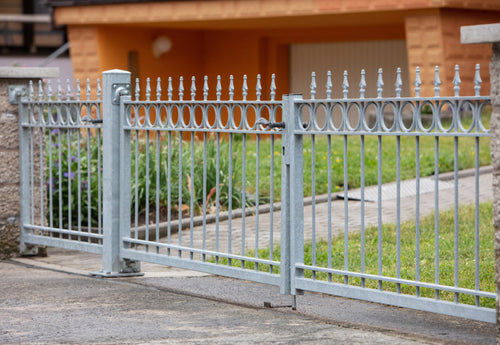
Pictured: Courtyard gate Padua in hot-dip galvanised finish
A thorough inventory must be taken before ordering material or drilling the first hole. The goal is to prevent a new operator from having to struggle against stiff or unstable mechanics. An apt comparison is a car with a powerful engine but dragging brakes – the performance does not translate to the road.
Checklist: Mechanics and geometry
- Gate weight and leaf width: These two factors determine the required force. The leverage exerted by a wide leaf is often more relevant than the pure weight.
- Smooth running: The gate must be able to be opened and closed manually with one hand, without jerking or squeaking, over its entire range of motion.
- Post stability: The posts must not give way under load. Wobbling posts lead to changing end positions and an unclean run.
- Condition of hinges and bearings: Play, rust, or dirt increase the resistance. Cleaning, lubrication, or replacement may be necessary.
- Opening direction and gradient: The opening angle must suit the available space. If the ground rises behind the gate, this must be taken into account for the mounting height.
- Wind load: Gates with closed infills, in particular, act like a sail in the wind and require operators with sufficient power reserves.
Which operator fits? Overview of common operator types
Anyone wanting to retrofit a gate operator should choose the operator type to suit the gate design, the available space, and the desired appearance. Not every operator is compatible with every post dimension or opening angle. An overview of the most important types:
| Operator type | Typically suitable for | What to look out for |
|---|---|---|
| Swing gate linear operator (spindle drive) | Single- and double-leaf swing gates with narrow posts | Exact adherence to the mounting distances (A- and B-dimensions), leverage ratios, limited opening angle. |
| Swing gate articulated arm operator | Swing gates with wide posts where a spindle drive does not fit geometrically. | Requires lateral space for the swivelling arm; be mindful of collision points with walls or fences. |
| Sliding gate operator (rack and pinion drive) | Sliding gates (both running on a track and cantilevered) | Quality of the track, clean installation of the toothed rack, stable foundation for the drive motor. |
The crucial factor for longevity is not solely the motor power, but the clean transmission of force. A precisely aligned operator with suitable geometry works more quietly, with less wear, and can be controlled more accurately.
Safety first – what to look out for regarding usage and surroundings
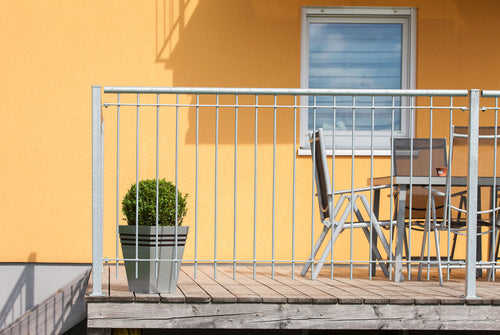
Pictured: Gate Ancona in hot-dip galvanised finish
Automatic gate systems develop considerable forces. Safety considerations therefore belong at the very beginning of any planning and are not an optional extra. You must analyse who uses the gate (children, visitors, delivery services), what the surroundings are like (adjacent public footpath, narrow passage), and whether pets might be in the movement area. The aim is to avoid crushing and shearing points from the outset or to secure them technically.
Important safety aspects when retrofitting
- Obstacle detection (force cut-off): The operator must stop immediately or reverse its direction of movement upon encountering unexpected resistance.
- Photocells or safety edges: These are essential for blind driveways or if people or vehicles could cross the gate's movement area.
- Emergency release: The gate must remain manually operable in the event of a power cut. The mechanism for this should be easily accessible.
- Warning light: A flashing light that is active whilst the gate is moving increases visibility and warns inattentive people.
- Professional electrical installation: Outdoor cables require protection against moisture (IP rating), UV radiation, and mechanical damage (e.g. by using conduits).
Step 1: Taking measurements and determining mounting points
Most problems when retrofitting a gate operator arise from inaccurately determined mounting points. Careful "dry planning" with a folding rule, spirit level, and the manufacturer's specifications for the operator is therefore essential.
What should be measured and documented
- Width and height of the gate leaf or the entire gate system
- Distances from the hinge pivot axis to the post edge
- Maximum possible and desired opening angle
- Positions for mechanical stops in the "open" and "closed" positions
- Safe and protected routing for the power cables
Practical tips for precise mounting points
- Draw markings with a waterproof pen and also take photographs
- Simulate the movement radius of the gate and the operator arm to rule out collisions
- Check the load-bearing capacity of the mounting surfaces (e.g. on hollow metal posts or old brickwork)
- Maintain sufficient clearance from decorative elements, locks, or hinges
Step 2: Mechanically installing and cleanly aligning the operator
For mechanical installation, the principle is: precision before speed. The operator must be positioned exactly so that it guides the movement rather than forcing it. Even slight deviations from the alignment can make running more difficult and drastically increase wear.
Basic installation rules
- Parallelism and alignment: The components must be installed so that the operator can work exactly in its intended path of movement. A spirit level is an indispensable tool here.
- Solid substrate: Fastenings must be made in load-bearing material. Depending on the substrate (concrete, brick, steel), suitable wall plugs or threaded screws must be used.
- Stable stops: Mechanical end stops are essential. They define the endpoint of the movement and prevent the operator from overshooting its target.
- Corrosion protection: Drill holes should be sealed, and only stainless steel screws and fastening materials should be used to prevent rusting.
Step 3: Preparing the power supply and control unit
The combination of electricity and the outdoors requires particularly careful planning. The power supply must be permanently stable and protected against all weather conditions. Low-voltage systems (e.g. 24V) are often safer here and easier to handle in a DIY context than 230V direct connections.
Preparations in the DIY project
- Determine cable routes and lay underground cables in protective conduits.
- Create wall penetrations so that they are angled slightly downwards to prevent water from entering.
- Choose the location for the control unit so that it is protected from direct weather while still accessible for maintenance work.
The electrical connection itself should only be carried out by suitably qualified persons. It is often a sensible division of labour to do the mechanical installation and the laying of conduits yourself, and have the final connection carried out by a qualified electrician.
Step 4: Setting the end positions and checking the travel paths
The end positions define the exact stop positions of the gate. This setting is crucial for the lifespan of the system. The gate should close reliably but not press forcefully against the stop. Many modern operators offer a "soft-start/soft-stop" function, where the movement is slowed down shortly before reaching the end position, which protects the mechanics.
How to realistically test the travel path
- Perform several complete opening and closing cycles to check for consistency.
- Look out for a smooth, quiet movement without jumps or abrupt stops.
- Check the clearances: leaves must not scrape anywhere, and sliding gates must not jump out of their guides.
- Adjust the end positions so that the gate locks securely but is not under constant mechanical tension.
Step 5: Testing safety functions and carrying out a test run
Commissioning follows installation. The test run serves to test all functions under realistic conditions, especially the safety devices.
Checkpoints for safe operation
- Obstacle detection: Test the reaction to an obstacle. A soft object (e.g. a cardboard box) placed in the travel path is suitable for this. The operator must stop.
- Photocell test: Interrupt the beam of the photocell during the closing process. The gate must stop immediately and ideally open again.
- Emergency operation: Try out the manual release to ensure that it runs smoothly and the procedure is clear in an emergency.
- Operating logic: Test all functions of the remote control, including any partial opening functions for pedestrians.
Common DIY mistakes – and how to avoid them
Courtyard gate Lucca in powder-coated anthracite
Many DIY projects suffer from recurring mistakes, which are usually due to a lack of preparation or a misjudgement of the mechanical basics.
- Treating symptoms instead of causes: A stiff gate will not run more smoothly just because a motor is pulling on it. First repair the mechanics, then automate.
- Installing by eye: Even minor deviations in alignment generate enormous leverage forces and lead to premature wear. Always work according to the manufacturer's instructions and with measuring tools.
- Under-dimensioned operator: To save money, an operator that is too weak is often chosen, which reaches its limits in the wind or cold and becomes overloaded.
- Unprotected cables: Cables left unprotected outdoors are a frequent source of error. UV radiation, moisture, and animals can damage the insulation.
Frequently asked questions on the topic
Can any courtyard gate be electrically retrofitted, even if it is older?
Yes, in many cases this is possible, provided the basic structure is stable and the mechanics are intact. With older gates, the hinges, post anchors, or stops are often the weak points. If these are repaired before the operator is installed, there is usually nothing standing in the way of automation. However, if the gate has already warped, posts wobble, or the frame shows cracks, the structural fabric should be renewed first.
Which tasks are realistically DIY when retrofitting a gate operator, and when is professional help needed?
Taking stock, measuring, the mechanical installation of the operator on a load-bearing surface, and laying conduits are typical DIY tasks. Professional support, on the other hand, is advisable as soon as foundations or posts need to be renewed, the gate system borders on public paths (keyword: duty to maintain safety), or the professional 230V electrical connection needs to be made.
What is particularly important when electrically retrofitting a garden gate?
When electrically retrofitting a garden gate, stable posts and play-free hinges are crucial, as these systems are often of a lighter construction. The frequently limited space requires precise planning of the opening angle to avoid collisions with hedges or walls. The wind load should also not be underestimated. A small but solid-surface gate can develop considerable forces that the operator must be able to handle.
Conclusion – With good preparation, retrofitting succeeds safely and reliably
Retrofitting a gate operator is a worthwhile DIY project that can succeed brilliantly with careful planning and execution. The formula for success is simple: first perfect the mechanical basis of the gate, then choose the right operator, precisely determine the mounting points, and finally test all control and safety functions conscientiously. The result is a significant gain in convenience and security, making everyday life a little easier each day.
A solid basis is the best starting point for automation. High-quality gates with a sturdy construction and precise workmanship create the ideal prerequisites for quiet, smooth, and long-lasting operator performance.
Discover our gates and garden gates – ideally prepared for retrofitting with a suitable gate operator in your DIY project.
Share article


