Metal railings or wooden railings – which material is the right choice?
The most important points in brief
- The choice of railing material depends largely on the installation location (outdoors/indoors), willingness to maintain it and budget.
- Outdoors, metal railings are usually the more durable and lower-maintenance solution: robust, weather-resistant and visually versatile.
- For fast and predictable construction projects, ELEO’s standardised metal railings offer a readily available, high-quality solution.
Choosing a railing for a balcony, terrace or staircase is far more than just a question of style. Whether metal railing or wooden railing – the chosen railing material has far-reaching consequences for safety, durability, maintenance effort and, not least, long-term costs. A railing fulfils two central functions: it ensures fall protection and at the same time shapes the architectural appearance of a building or room. While aesthetics and feel play a major role indoors, outdoors the focus is on resistance to weather, UV radiation and moisture. This article provides a well-founded decision-making guide, compares the most common materials in practical terms and shows which solution is best suited to which area of use.
The most important railing materials at a glance
In residential construction, steel (often referred to as metal), wood, aluminium, stainless steel and glass are the most common materials. Each of these materials has specific properties that make it more or less suitable for particular applications. An objective comparison of the key criteria is the first step towards making the right choice.
Comparison table of materials
| Material | Durability | Maintenance effort | Costs (purchase) | Ideal for |
|---|---|---|---|---|
| Metal (steel, galvanised & coated) | Very high | Low | Medium | Metal balcony railing, metal stair railing (outdoors & indoors), durable and low-maintenance solutions. |
| Wood | Medium (indoors) to low (outdoors, depending on wood type & protection) | Medium (indoors) to very high (outdoors) | Low to medium | Wooden stair railing indoors, sheltered areas, focus on a natural and warm appearance. |
| Aluminium | High | Very low | Medium to high | Modern architecture, lightweight constructions, when corrosion must be avoided completely. |
| Stainless steel | Very high | Low | High | High-end, modern buildings, high requirements for corrosion resistance (e.g. near the coast). |
| Glass (with metal frame) | High (with laminated safety glass) | High (frequent cleaning required) | High to very high | Maximum transparency, wind protection, light-filled areas with unobstructed views. |
Metal railings – robust, durable and timeless
A steel metal railing is the pragmatic and often also the most economical long-term solution, especially when safety and low maintenance are priorities.
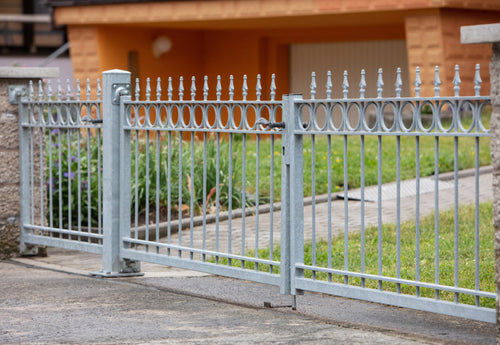
The decisive advantage of a metal railing lies in its industrial finishing: through hot-dip galvanising, the steel core is coated with a protective zinc layer that protects it against corrosion. A subsequent powder coating not only gives the railing the desired colour, but also creates an additional, extremely resistant and smooth protective barrier against weather influences and mechanical stress. This combination makes metal railings extremely durable.
In addition, metal is enormously flexible in terms of design. From delicate, ornate designs in country-house style to strictly geometric, minimalist forms for modern architecture, almost anything is possible. The slim profiles of metal bars also allow for an open look and unobstructed views, which is particularly appreciated on balconies.
Metal railings for balconies – advantages outdoors

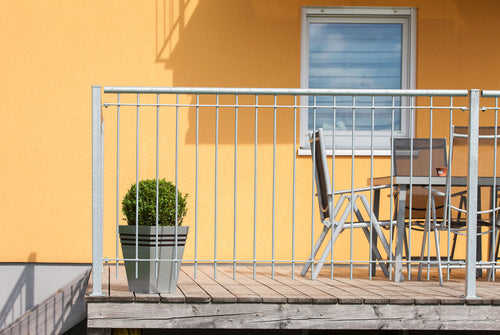
A metal balcony railing is permanently exposed to wind, rain, snow and UV radiation. This is where the material fully demonstrates its strengths:
- Dimensional stability: Metal does not warp, swell or become brittle. Its structural load-bearing capacity remains constant for decades.
- Weather resistance: The combination of galvanising and powder coating provides decades of protection against rust. Water simply beads off.
- Ease of maintenance: Regular cleaning with water and a mild cleaner is enough to keep the surface clean. No annual painting or oiling is required.
- Safety: Metal offers high strength. The connections are usually welded or robustly screwed together, ensuring a permanently stable construction.
When planning a balcony railing, the building regulations specific to each federal state must be observed. The article Regulations for balcony railings provides a useful overview of the most important rules.
Metal railings for stairs – indoors and outdoors
Steel is also an excellent choice as a metal railing for a staircase. Outdoors, the same advantages apply as with balcony railings: robustness and weather resistance are unbeatable. Indoors, a metal railing impresses with its slim, elegant appearance, which combines excellently with other materials such as wooden steps, exposed concrete or natural stone. It appears less bulky than a solid wooden railing and can therefore give even small or narrow stairwells an airy atmosphere. Installation is flexible – whether fixed to the side of the stringers, on the steps or on the landing.
Our metal railings
Care and maintenance of metal railings
The maintenance effort is minimal. It is advisable to clean the railing once or twice a year with a soft cloth and a neutral soap solution in order to remove dirt and aggressive deposits. Regular visual inspection of the coating is important. If strong mechanical impact causes damage, the affected area can be repaired with a touch-up pen in order to maintain uninterrupted corrosion protection.
Wooden railings – natural and warm

A wooden railing radiates naturalness and warmth. Its pleasant feel and classic appearance make it a popular choice indoors, especially when it is intended to harmonise with wooden floors or doors. Wood is an organic material that reacts to its surroundings. This property, which can contribute to a pleasant indoor climate inside, becomes its greatest challenge outdoors.
Wooden railings for balconies – what should you consider?
A wooden balcony railing is exposed to constant fluctuations in moisture and UV radiation. This leads to high maintenance requirements and potential problems:
- Constructive wood protection is crucial: Water must be able to drain away everywhere. Horizontal surfaces, unprotected end-grain edges or poorly ventilated connections are entry points for rot and fungal attack.
- Regular maintenance is unavoidable: Depending on the type of wood and the level of weather exposure, a wooden railing must be sanded down and re-glazed or repainted every two to five years in order to protect it from greying and moisture damage.
- Material fatigue: Wood moves. It swells in moisture and shrinks in dry conditions. This can lead to cracking, screw connections can loosen and stability can decrease over the years. Splintering is also a common problem.
Wooden railings for stairs – advantages and disadvantages
In protected indoor spaces, a wooden stair railing is an aesthetically appealing solution. The stresses caused by weather are absent. Nevertheless, there are aspects to consider: the handrail of a heavily used stair railing can show signs of wear over time. Soft types of wood are prone to dents and scratches. A high-quality, robust varnish or hard-wax oil treatment is essential here to protect the surface in the long term.
Maintenance effort – why wood is demanding outdoors
The greatest weakness of wood outdoors is its susceptibility to moisture and UV light. Without an intact protective layer, the decomposition process begins. This means a recurring cycle of inspection, cleaning, sanding and repainting. This effort should not be underestimated. For anyone looking for a low-maintenance solution for a balcony or outdoor staircase, wood is often not the right choice.
Other materials at a glance
Besides the two main materials, metal and wood, there are other materials that are interesting for specific requirements.
Aluminium – lightweight and easy to maintain
Aluminium does not rust and is very light. It is often used for system railings with plug-in or screw connections. The surfaces are usually powder-coated or anodised. Aluminium is ideal for modern designs and wherever low weight is an advantage, for example when renovating balconies with limited load-bearing capacity.
Stainless steel – modern and corrosion-resistant
Stainless steel (usually V2A, or V4A near the coast) is extremely durable and corrosion-resistant. Its cool, silver-matt or polished appearance is a perfect match for modern architecture. Stainless steel is easy to maintain, although fingerprints and water marks are quickly visible on polished surfaces. The higher material and processing costs make it a premium option.
Glass – light-filled but high-maintenance
Glass railings, usually made from laminated safety glass (LSG), offer maximum transparency and a feeling of spaciousness. They are also excellent as wind protection. The biggest disadvantage is the high cleaning effort, as every mark is immediately visible. The construction must also meet high structural requirements, which makes planning and installation more demanding.
Which material suits which area of use?

The final decision on railing material should be based on a sober assessment of location, intensity of use and personal willingness to maintain it.
Outdoors – balcony and terrace
For outdoor areas, a metal railing for the balcony or terrace is the superior choice in most cases. It offers the best combination of durability, safety and low maintenance. The lifecycle costs – that is, purchase plus maintenance over the years – are often lower for a high-quality metal railing than for a supposedly inexpensive wooden solution that requires regular costly coatings.
Indoors – stairs and stairwells
Indoors, the decision is more strongly shaped by aesthetics. A wooden stair railing creates a homely atmosphere. A metal stair railing, on the other hand, often appears more modern and open. Here, personal taste is decisive, although the robustness of metal remains a practical advantage in heavily used areas.
Decision tree
These points help narrow down the right material:
- For permanent outdoor use weather-resistant materials such as hot-dip galvanised steel, aluminium or stainless steel clearly have the advantage. Wood is only an option with a high willingness to maintain it and ideal structural conditions.
- Anyone who wants minimal maintenance, should choose metal, aluminium or stainless steel. Wood is the most maintenance-intensive option, especially outdoors.
- If a warm, natural look is the priority, wood is an excellent choice indoors. Outdoors, a similar appearance can often only be maintained with considerable effort.
- When considering lifecycle costs a solid metal railing is often the more economical decision compared with an inexpensive wooden railing that causes recurring maintenance costs.
- For fast and calculable construction projects railings in standard dimensions are ideal, as they combine planning certainty with immediate availability.
Legal requirements – brief overview
Regardless of the material chosen, every railing must meet the statutory safety requirements. These are laid down in the state building regulations of the respective federal states and relate in particular to railing height depending on fall height, the spacing of vertical bars (to prevent children from climbing through) and overall stability. Addressing these regulations at an early stage is essential in order to avoid costly rework.
Minimum heights for balcony and stair railings
The minimum heights vary depending on the federal state and the fall height. As a rule of thumb, the following often applies: for a fall height of up to 12 metres, a railing height of at least 90 cm is required; for greater fall heights, it is often 110 cm. Precise and binding information can be found in the respective state building regulations. The linked article provides a helpful summary: Regulations for balcony railings.
Frequently asked questions
1) Which railing material is most durable outdoors?
Hot-dip galvanised and powder-coated steel as well as stainless steel are the most durable materials for outdoor use. They provide reliable protection against corrosion and weather influences for decades with minimal maintenance. Aluminium is also very durable. In direct comparison, wood has a significantly more limited service life unless it is maintained extremely thoroughly and is structurally optimally protected.
2) Is a wooden railing on a balcony a sustainable choice?
The sustainability of a wooden railing depends on several factors: the origin of the wood (e.g. FSC certification), the type of glazes and paints used (often chemical) and its service life. A railing that has to be replaced after 15 years is less sustainable than a metal solution that lasts 40 years or longer. Repeated chemical treatments can also negatively affect the environmental balance.
3) Can the look of wood be combined with the durability of metal?
Yes, this is a common and highly recommended approach. A very stable and low-maintenance solution is a metal railing as the basic structure, combined with a wooden handrail. This combines the robustness of metal on the critical parts exposed to the weather with the pleasant feel of wood on the handrail. This combination is also very popular indoors.
Choosing the right railing material is a long-term investment in the safety and value of a property. While wood scores with its natural appearance, metal impresses with unrivalled durability and minimal maintenance, especially in demanding outdoor areas. A careful assessment of the criteria mentioned here will reliably lead to the right decision for your construction project.
Discover our high-quality metal railings – available immediately in standard dimensions.
Tipp: At ELEO Express you can get a metal balcony railing for under €100 per element.
Share article
