

The most important points at a glance
- For optimal sun protection on the balcony, classic solutions such as parasols, space-saving balcony umbrellas, awnings, or flexible sun sails are suitable – each adapted to the balcony area and budget.
- Natural shade can be created through the targeted use of plants and climbing plants such as ivy or wisteria, which, in addition to providing protection, also ensure a pleasant microclimate.
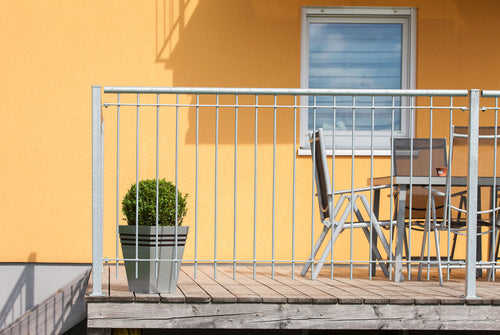
- A sturdy balcony railing from ELEO, such as the Ancona railing, is recommended as a base for mounting various sun protection solutions. It is available in different coatings and combines functionality with individual design.
Sunbathing on the balcony is lovely – up to a point. Especially on hot summer days, the sun's rays can quickly become too intense. Shade is needed. Which sun protection solution is the best choice for your balcony? We explain it all in our guide.

Versatile classic: the parasol
A shade-providing evergreen for sun protection on the balcony is undoubtedly the parasol. It is available in a wide variety of sizes and designs. Classic center-pole parasols have a central pole and are usually round or rectangular. The disadvantage is that they take up a relatively large amount of space and are more suitable for large balconies, terraces, and gardens. A good alternative is balcony parasols, which are increasingly available on the market. These can be mounted directly on the balcony railing, are flexible, and take up far less space. They are particularly well-suited for small balconies.
Regardless of which parasol model you choose, when selecting a parasol, make sure it fits the size of your balcony and is sturdy enough to withstand gusts of wind.
- Center-pole parasols: well-suited for large balconies
- Balcony parasols: well-suited for small balconies

Tried and tested: the awning
An awning offers complete sun protection for your balcony. It is mounted to the house wall and can be extended and retracted as needed. Awnings are available in various designs, e.g., as folding arm awnings (electric or with a hand crank), cassette awnings, or awnings with a valance. If you have a loggia, vertical awnings, which are mounted between the balcony railing and the ceiling, are a good option. A clear advantage is that awnings don't take up any space on the balcony. However, a disadvantage is that they are quite expensive – especially electrically operated models – and relatively susceptible to weather damage. In bad weather, an awning should always be retracted.
- Advantages of an awning: complete shading of the entire balcony is possible, easy to use
- Disadvantages of an awning: expensive to purchase, susceptible to weather, requires maintenance

Sun sails are flexible and easy to install – but also susceptible to weather and unstable. Image source: stock.adobe.com, contrastwerkstatt
Affordable and flexible: Sun sails
A sun sail is an affordable and flexible alternative to awnings and parasols and is particularly suitable for sun protection on smaller balconies. The sun sail can be attached to the balcony railing or the house wall at various points. Sun sails are available in different shapes and sizes and made from different materials. However, keep in mind: A sun sail made of a dense fabric should be taken down when it rains. Otherwise, water will collect, the fabric will sag, and in the worst case, the sail will tear.
If you want to use a sun sail not just temporarily, but permanently, we recommend a model made of water-permeable material. There are sun sails that are made with a looser mesh. They provide ample shade but allow rainwater to pass through.
- Advantages: inexpensive to purchase, flexible in use, uncomplicated
- Disadvantages: susceptible to weathering, usually only lasts one season

Natural shade with plants
Plants are natural shade providers. The larger and bushier they are, the more shade they cast and the more they can shield against direct sunlight. Therefore – and also to offer bees and butterflies a colourful buffet – you should bring as many plants as possible to your balcony.

Climbing plants such as ivy, wisteria, or clematis can also be used as sun protection for the balcony – keyword: vertical gardens. Climbing plants can grow up trellises that are attached to the balcony railing. There are various plant supports in different shapes and sizes.
By the way, plants on the balcony not only provide natural sun protection. They also contribute to a cooler atmosphere, as the plants release moisture through their leaves. This provides evaporative cooling.
Overview: What is the best sun protection for your balcony?
|
Sun Protection |
Advantages |
Disadvantages |
|
Center-pole parasol |
Provides ample shade, easy to use, flexible in application |
More suitable for large balconies, high-quality models are relatively expensive, susceptible to weather conditions |
|
Balcony umbrella |
Relatively inexpensive, space-saving installation on the balcony railing, flexible in use |
Limited shade, possible damage to the balcony railing from scratches, susceptible to weather conditions |
|
Awning |
Complete balcony shading, easy to use |
Expensive (especially with electrically operated awnings), high maintenance, susceptible to weather conditions |
|
Vertical awning |
Effective sun protection, easy to use |
Blocks the view from the balcony, only suitable for loggias, susceptible to weather conditions |
|
Sun sail |
Affordable, diverse designs, easy installation, flexible use |
Not very durable, provides only limited shade, susceptible to weather conditions |
#include-related-slider#


