



Key Points at a Glance
- Whether tenants are permitted to erect a fence depends on the type of fence and the provisions set out in the tenancy agreement.
- A written agreement, compelling arguments, and a reversible installation concept help to avoid disputes with landlords and neighbours.
- High-quality metal fences offer a durable solution. Where permission is not granted, plug-in fences from ELEO Express are an ideal alternative that requires no structural intervention.
The desire to demarcate one's own garden area, create greater privacy, or provide a safe outdoor space for children and pets is a central concern for many tenants. Yet the question quickly arises: is a tenant permitted to erect a fence? What matters here is not only the personal wish for order and security, but above all the legal classification. Does the fence constitute a structural alteration requiring permission, what does the tenancy agreement stipulate, and what neighbourly law requirements must be observed? This guide systematically works through the legal framework and sets out practical approaches for a stress-free and legally sound implementation.
The short answer upfront – am I allowed to erect a fence as a tenant?
In principle, the answer in many cases is: yes, but explicit consent from the landlord is often required. The decisive point is whether the planned fence is considered part of the contractual use of the rented property or whether it constitutes a structural alteration. As soon as a fence is permanently anchored in the ground or significantly alters the appearance of the property, permission becomes unavoidable. For mobile, easily removable solutions the scope is greater, though the tenancy agreement and house rules remain authoritative even here.
Fixed fence vs. mobile privacy screen – the crucial distinction
For the purposes of legal assessment, the distinction between a permanently installed fence and a mobile boundary is of central importance.
A fixed fence is characterised by a permanent connection to the ground. This includes posts that are set in concrete, the use of bolted or concrete foundations, and drilling into walls or paved surfaces. Such measures interfere with the fabric of the rented property and are clearly regarded as structural alterations requiring consent.
A mobile privacy screen or a reversible enclosure, by contrast, requires no permanent anchoring. Plug-in systems that are simply inserted into the ground, or freestanding elements, can be removed at any time without leaving a trace. They are more likely to fall within "contractual use", provided they do not substantially detract from the overall appearance and do not inconvenience neighbours.
As a rule of thumb: the more involved the installation and the more difficult the removal, the more likely permission will be required.
Traffic-light overview (Box: Green / Amber / Red)
| Signal | Typical case | Recommended action |
|---|---|---|
| Green | Light, reversible boundaries (e.g. plug-in fence) within an exclusively used garden area, without any intervention in the ground or the building fabric. | Check the tenancy agreement for specific prohibitions. A brief notification to the landlord builds goodwill but is often not strictly required. |
| Amber | A fence that visibly shapes the appearance of the property, sits on a boundary, touches communal areas, or exceeds a certain height. | Written consent from the landlord must be obtained in advance, with details such as material, height, and removal obligations agreed upon in binding terms. |
| Red | Any form of foundation (concrete, bolts), drilling into walls, interference with paving, or permanent anchoring that cannot be removed without leaving a trace. | Must not be carried out without explicit written permission. Removal orders, claims for damages, and tenancy disputes may follow. |
When is the landlord's consent required?
The landlord's consent is always required when the planned garden fence at the rented property constitutes a structural alteration, interferes with the building fabric, or affects the rights of third parties (e.g. neighbours or other tenants). A careful reading of the tenancy agreement is the first and most important step.
What counts as a structural alteration?
A structural alteration occurs when the condition of the rented property is permanently changed beyond ordinary use. Typical indicators include:
- Permanent connection with the ground via concrete, point, or bolt foundations.
- Interference with the building fabric, such as drilling into house walls, terrace boundaries, or garden walls.
- A lasting and material change to the overall visual impression of the property.
- Erection on a property boundary, which also raises questions under neighbourly law.
- Deviation from a uniform design scheme stipulated for a residential estate or development.
The key for tenants therefore lies in choosing a method of installation that guarantees complete and traceless removal.
What does the tenancy agreement say – what should you look out for?
Before selecting materials, the tenancy agreement should be reviewed carefully. The following clauses are particularly relevant:
1. Right of use over the garden
Is the garden explicitly included in the tenancy and granted for sole use? Or is it a communal area for shared use? An exclusive right of use considerably strengthens the tenant's negotiating position, but does not replace the need for permission in the case of structural interventions.
2. Provisions regarding fixtures and alterations
Many agreements contain clauses that explicitly subject structural alterations, the installation of enclosures, or the design of external areas to a requirement for prior consent. The house rules may also contain corresponding provisions.
What happens if you act without permission?
Anyone who erects a fence without the required consent takes on considerable risk. The landlord may demand immediate removal at the tenant's expense. Should damage to the property result, a claim for compensation may arise. In the worst case, such conduct in breach of the tenancy agreement can lead to a formal warning or even termination of the tenancy. Acting early and transparently is therefore always the better strategy.
Convincing your landlord: the right arguments
Most landlords do not reject a fencing project on principle, but out of concern about damage, future costs, or an unsightly result. A well-prepared request that proactively addresses these concerns has a high chance of success.
The best arguments to put to your landlord
- Added value and security: A high-quality, stylish fence can enhance the appearance of the property and increase security by deterring unauthorised access.
- Protection of the garden: The fence protects planted beds, lawns, or a garden pond from damage and creates a clear structure within the outdoor area.
- No structural intervention: The assurance that a reversible installation method will be used – without concrete or drilling – removes the landlord's greatest concern.
- Professional appearance: The choice of a durable, low-maintenance material such as powder-coated steel signals a considered solution rather than a makeshift one.
- Cost responsibility: A clear commitment that all costs for purchase, installation, maintenance, and eventual removal will be borne by the tenant.
Written request – what matters
An informal e-mail is often not sufficient. A structured, written request should bring together all relevant information:
- A precise description of the project (site plan or sketch of the fence layout).
- Details of the material, colour, and height of the fence (e.g. with a product photograph).
- A detailed explanation of the planned installation method, with emphasis on reversibility.
- An explicit commitment to complete removal upon vacating the property.
- An offer to draw up a written supplementary agreement to the tenancy agreement.
This approach demonstrates professionalism and gives the landlord the reassurance needed to reach a positive decision.
What to do if the landlord says no?
A refusal often relates to a specific design, not to the underlying wish itself. It is worth enquiring about the precise reasons. Is it the height, the material, or concern about a foundation? On that basis, compromises can be offered: a lower fence, a more open design, or a switch to a purely plug-in, mobile solution.
Who pays for the fence – tenant or landlord?
The allocation of costs depends on whether the fence represents a maintenance measure by the landlord or an individual request by the tenant.
When is the landlord responsible?
A landlord's obligation to bear costs arises only in exceptional circumstances – for example, when a fence already present at the start of the tenancy is defective and requires repair, or when a fence is necessary to fulfil safety obligations (e.g. on a slope). If the landlord themselves wishes to have a uniform enclosure installed across the entire residential development, they likewise bear the costs.
When does the tenant bear the costs?
As a general rule: if the fence primarily serves the tenant's personal needs – such as greater privacy, keeping a pet, or improving the appearance of the garden – the costs are to be borne entirely by the tenant. This includes purchase, installation, and maintenance.
Removal upon vacating – what do you need to be aware of?
Unless otherwise agreed, the tenant must restore the rented property to its original condition upon vacating. This means the fence must be removed completely and without leaving any trace. It is advisable to record this in a written agreement. In some cases the landlord may be interested in retaining the fence, particularly if it represents a high-quality improvement to the property. A handover arrangement can then be agreed upon.
Neighbourly law – what else applies?
Even with the landlord's consent, the project is not automatically approved. The neighbourly law of the respective federal state sets further boundaries that must be observed to avoid disputes.
Setback rules and permitted fence height
The regulations governing maximum fence height and the required distance from the property boundary vary from state to state. An important concept here is the "locally customary enclosure": a fence that corresponds to the type, height, and material of neighbouring properties is generally unproblematic from a legal standpoint. To minimise the risk of conflict, it is often simplest to erect the fence with a clear setback from the boundary, within the tenant's own area.
Does the neighbour need to give consent?
If the fence is erected entirely within the rented property, formal consent from the neighbour is generally not required. Nevertheless, a friendly advance notification is a matter of courtesy and can nip many potential problems in the bud. If the fence is to run directly along the property boundary, however, the neighbour's consent is strictly required.
Tenant-friendly fencing solutions – reversible and stylish

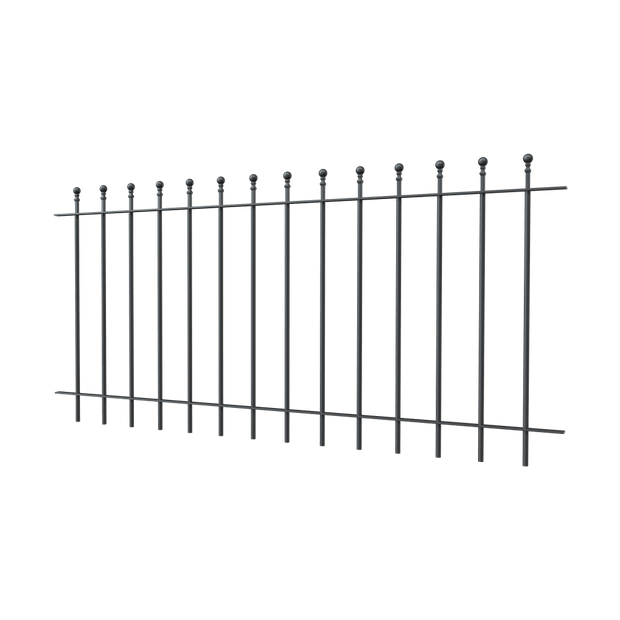
Pictured: Padua Fence in powder-coated special colour black.
The question of whether a tenant is permitted to erect a fence ultimately comes down to choosing the right product. Ideal solutions are those that are robust and aesthetically pleasing, whilst at the same time offering the flexibility that a tenancy demands.
Why metal fences are the best choice for tenants
Modern metal fences, particularly those made from powder-coated steel, offer tenants decisive advantages:
- Aesthetics and quality: Clean, slender designs look high-quality and suit a variety of architectural styles without being obtrusive. This increases the likelihood of acceptance by the landlord.
- Exceptional durability: Unlike timber, which can weather, requires painting, and may need repairing, high-quality metal fences are maintenance-free. This saves the tenant time and expense.
- Stability and safety: They provide a robust and reliable boundary that is also suitable for the safety of children or pets.
- Reversibility: Many systems are modular in construction and can be dismantled when moving, potentially taken along or resold.