
- Gabions used as a privacy screen offer a distinctive stone look and a high level of screening, but they take up comparatively large amounts of space and require a load-bearing foundation.
- A metal privacy screen fence requires less installation depth, does not need stone infill and is therefore particularly suitable for narrow areas of a property.
- The metal products from ELEO Express enable a clearly structured design and can be planned at short notice in standard dimensions.
A privacy screen should provide privacy, match the style of the house and garden, and be possible to install with a reasonable amount of effort. Gabion fences and metal privacy screens fulfil this task in different ways. While gabions create a heavy, stone-focused effect through filled wire baskets, a metal fence forms a much slimmer property boundary. The choice therefore depends not only on taste and screening density, but also on available space, ground conditions, the foundation, delivery conditions, maintenance and the full project costs.
Gabion fence and privacy screen fence at a glance
What is a gabion fence?

A gabion fence consists of wire baskets that are filled with stones on site. The colour, shape and grain size of the material determine the appearance. Evenly layered stones tend to look more ordered and architectural, while a loose fill creates a more rustic impression. The filled baskets can form a largely closed surface and are often used as a distinctive design element.
However, the construction is material-intensive and heavy. In addition to baskets, posts and connecting elements, large quantities of suitable stones are required. The foundation, access and transport routes must therefore be taken into account before ordering. The basket depth is also significant when planning the area: along narrow paths or small patios, the solid construction can take up valuable usable space.
What is a metal privacy screen fence?

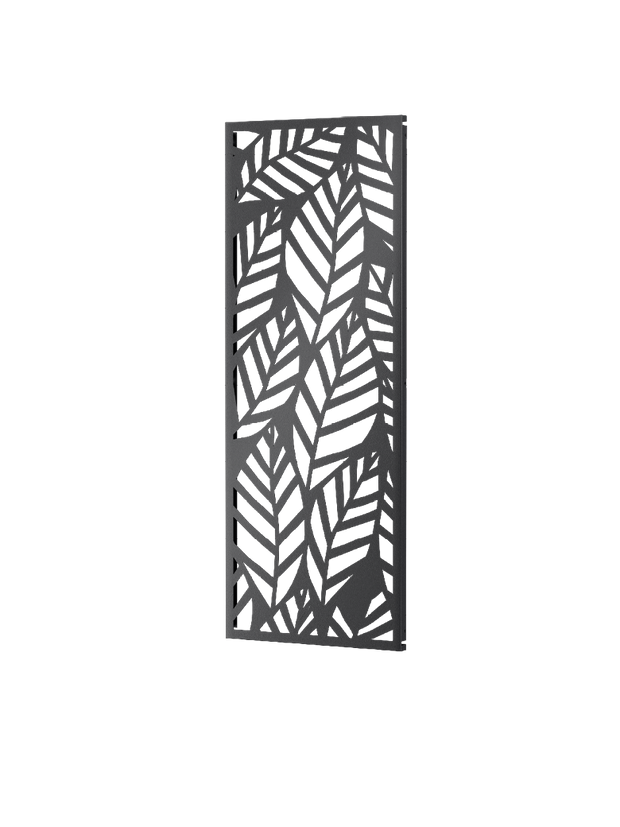
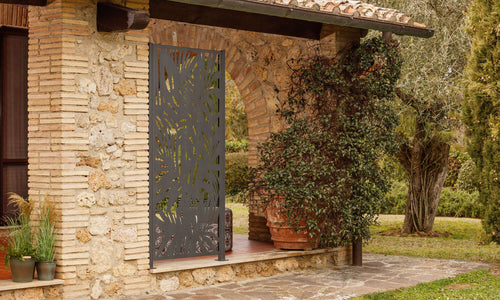
The Amato privacy screen from ELEO Express provides privacy and blends into clearly designed outdoor areas with its slim construction.
A metal privacy screen fence usually consists of posts, fixings and screening or closed elements. The straight-lined design language fits particularly well with clearly structured outdoor areas. As no bulky infill is required, the construction remains slim and can also be integrated along sides of a property where space is limited.
Metal products from ELEO Express offer an alternative for projects where straightforward planning and standard dimensions available at short notice are important. The structure is assembled in repeating sections between the posts. This allows the length, position and course of the fence to be defined precisely before installation.
Gabions as a privacy screen: advantages and disadvantages at a glance

Appearance and screening density
The particular strength of a gabion lies in its three-dimensional stone surface. It appears strong, structured and, depending on the infill material, highly individual. With a suitable grain size and dense, even filling, a high level of privacy screening is achieved. However, small gaps between the stones cannot be completely avoided in every design.
At the same time, the massive effect can be a disadvantage. In spacious areas, a gabion wall creates a deliberate accent; in small gardens, by contrast, it can appear dominant. A metal privacy screen fence forms a flatter, visually calmer surface. How opaque it is depends on the design of the elements, their spacing and the transitions at posts or corners.
Weight, foundation and space requirements


When weighing up the advantages and disadvantages of gabions, weight plays a central role. Even a short, tall fence holds a considerable fill volume. The ground must be able to bear this load without the structure settling or leaning. Depending on the height, design and soil conditions, load-bearing foundations, a compacted sub-base and concreted-in posts may be required. The specific design should suit the respective system and location.
Metal privacy screen elements also require securely anchored posts. Here, however, the load is not created by stone infill. Particular attention should be paid to the fence height, element width, ground conditions and wind load. Closed surfaces offer the wind more area to act on than open fences, which is why the foundation and fixing should not be selected on visual criteria alone.
The systems also differ significantly in terms of space requirements. A gabion basket with a depth of several decimetres reduces usable paths, beds or seating areas. Metal profiles and fence elements require less installation depth. This makes design easier along driveways, patios and narrow property boundaries.
Gabion fence costs: what a gabion fence really costs
Cost factors at a glance
Gabion fence costs consist of more than just the purchase price of the wire baskets. For a meaningful comparison, all project components must be included:
- Wire baskets, posts, spacers, connections and fixing material
- Infill stones in a suitable grain size and sufficient quantity
- Foundation material, sub-base and necessary earthworks
- Delivery and transport from the unloading point to the fence line
- Installation, alignment of the baskets and even filling
- possible additional work on slopes, corners or areas that are difficult to access
The stones influence the overall effort in several ways. In addition to the material price, the delivery weight, distance to the installation site and the question of whether technical aids can be used are all relevant. A narrow access route or steps between the road and garden make moving the material more difficult. A visible side arranged by hand also requires more working time than a simple loose fill.
Sample calculation
A gabion fence that is two metres high, 30 centimetres deep and ten metres long theoretically requires six cubic metres of filling material. Depending on the type of stone, this equates to around ten tonnes of stones. Assuming a stone price of £85 to £130 per tonne, the filling alone costs around £850 to £1,300.
In addition, there are the gabion baskets, delivery, foundation work and installation. For the entire example project, the costs can amount to around £4,000 to £8,000 if carried out professionally. The actual expenditure depends, among other things, on the type of stone, the ground conditions and the accessibility of the property.
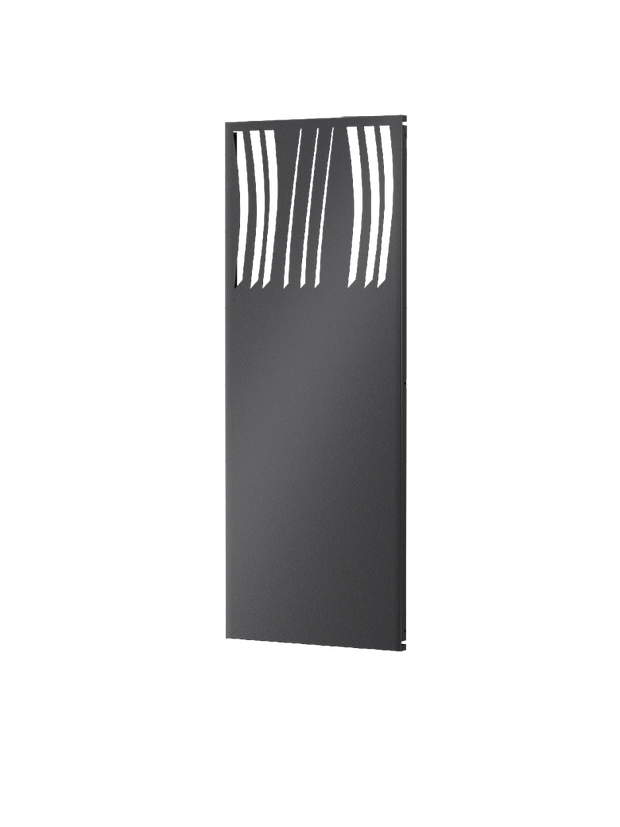
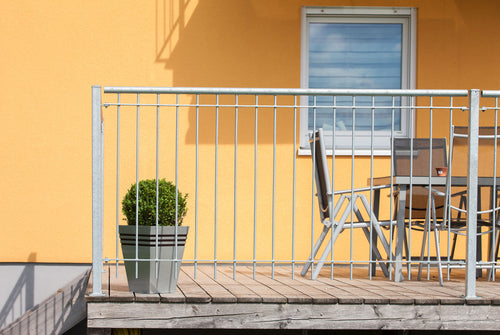
With a metal privacy screen fence, there is no need for time-consuming stone filling. The Pesa metal privacy Screen from ELEO Express, for example, is available from as little as £247.48 per element. Posts, foundations and, where applicable, installation costs are additional. The easier handling of the material can be an advantage, especially for longer fence sections. For a fair cost comparison, however, the same fence dimensions and installation conditions should always be taken into account.
Metal privacy screen fence: advantages and disadvantages
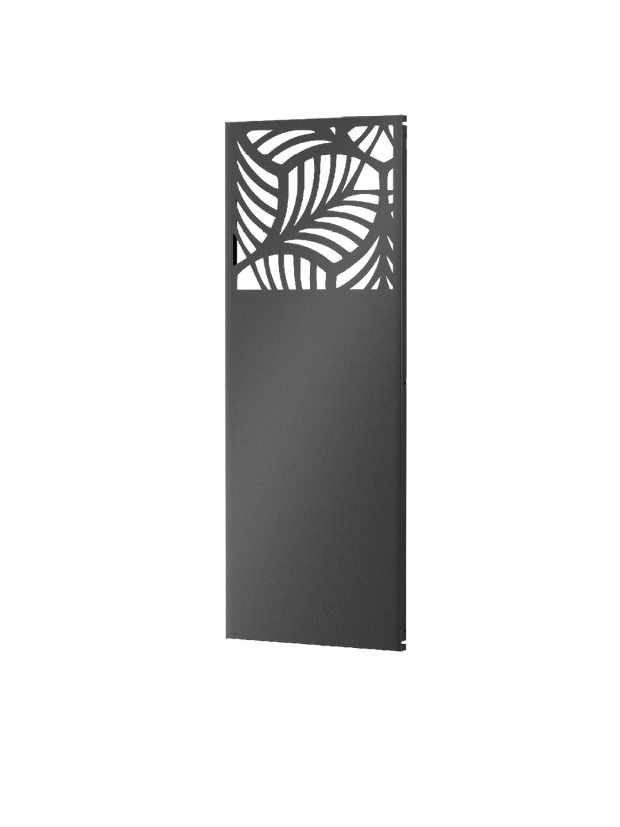
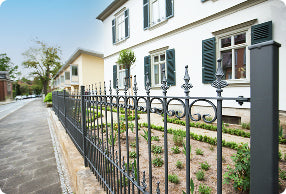
 The Liro metal privacy screen from ELEO creates a calm backdrop for garden design and requires only a small installation depth.
Slim design and low space requirement
The shallow installation depth is particularly relevant when every centimetre between the property boundary and the path needs to be used. Planting areas, garden furniture or storage areas can be positioned closer to the fence. At the same time, a clear spatial separation is created. For modern buildings and gardens laid out with straight lines, metal offers an understated alternative to the pronounced structure of a stone wall.
One possible disadvantage to consider is the different material effect. A metal surface does not replace the solid character of a gabion. In addition, closed elements can appear compact in unfavourable light or at a great height. A harmonious division of the fence panels and a height matched to the property improve the proportions.
Construction and availability
A metal fence is built in sections from posts and elements. After measuring, post positions, centre-to-centre distances and heights are determined. This is followed by foundation work, alignment and installation of the surfaces. Unlike a gabion fence, there is no need to deliver and distribute large quantities of stone. This reduces the number of work steps on the property.
Standard dimensions make it easier to determine quantities and can enable prompt implementation, provided the desired components are available. Before ordering, the total length, corner points, height differences and any possible special sections should be checked. This helps to avoid unnecessary cuts or unsuitable distances.
Durability and maintenance
How a fence develops in use depends on the material design, location, installation and level of stress. General statements about service life are therefore not useful. With gabions, wire baskets, connections, posts and the position of the stones should be checked regularly. Settlement in the subsoil or displaced fillings may make corrections necessary.
With a metal fence, ongoing checks mainly cover posts, screw connections, transitions and visible changes to the surface. Depending on the respective design, dirt can be removed with suitable, mild products. Checking conspicuous areas at an early stage helps to identify necessary measures in good time.