

The key points at a glance
- At ELEO Express, the duplex coating combines KTL e-coating as the base layer with powder coating as the colour-providing topcoat.
- The two-stage structure helps protect outdoor metal products against corrosion and provides an even finish.
- For ELEO products, anthracite and special colours in any RAL shade are available, allowing the coating to be matched to the chosen design scheme.
For outdoor fences, gates and railings, the coating fulfils two tasks: it protects the metal surface from the weather while also determining its appearance. ELEO Express uses a coordinated coating system comprising KTL e-coating and powder coating for this. The two layers perform different functions and together form the duplex system. In addition to functional protection, the process offers a wide choice of colours, from classic anthracite to custom RAL shades.
What is a duplex coating?

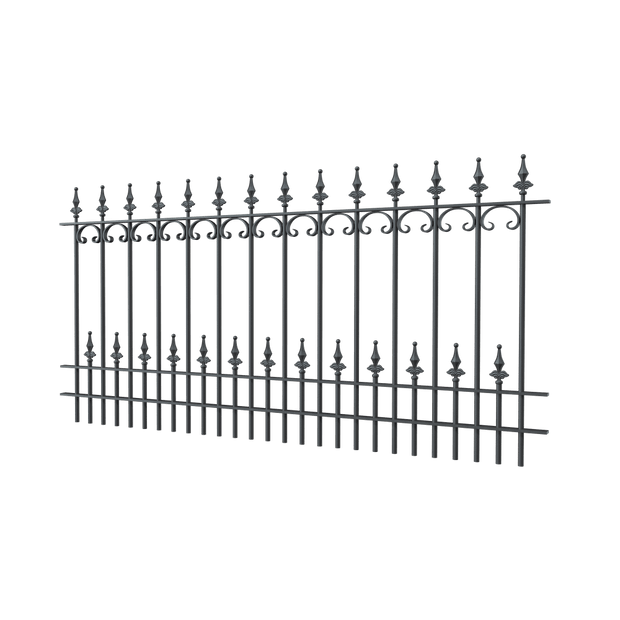
The Lucca fence from ELEO features decorative finials and an anthracite finish applied using the duplex system.
The term duplex essentially describes a system consisting of two coatings. Instead of applying just a single layer to the metal, a base coat and a topcoat are combined. The primer creates the basis for corrosion protection and for the adhesion of the topcoat. The layer above provides additional shielding for the surface and determines the colour, texture and visual effect.
The quality of such a structure results from the combined effect of the individual processing stages. Careful pre-treatment, an evenly applied primer and a suitable topcoat must therefore be considered together. This applies especially to metal products with edges, joints, ornaments or areas that are difficult to access.
Duplex at ELEO Express: KTL and powder coating
At ELEO Express, duplex stands for the combination of cathodic electrocoating (KTL) followed by powder coating. The prepared metal first receives a base coat by immersion. The coating powder is then applied and oven-cured. This creates a coloured topcoat over the KTL primer.
This structure is suitable for fences, gates and railings that are exposed outdoors to rain, moisture and changing temperatures. At the same time, the coating preserves the visible shapes of the metal product: structures with clean lines remain clearly recognisable, while decorative elements and contours can be highlighted by a uniform colour finish.
Different duplex coating systems
In general usage, a duplex coating is often associated with a combination of hot-dip galvanising and an additional colour coating. At ELEO Express, however, the term specifically refers to the combination of KTL and powder coating. The term alone therefore does not provide complete information about the process used.
At ELEO Express, hot-dip galvanising is a separate finish. It is not automatically part of a powder-coated product. A meaningful comparison therefore depends on the actual coating system: KTL plus powder coating on the one hand, hot-dip galvanising as a separate finish on the other.
The duplex coating process, step by step
Blasting and pre-treatment for the duplex process
Before the primer and colour layer are applied, the metal surface must be prepared. Blasting removes residues and impurities. At the same time, the surface is given a texture that supports the adhesion of the subsequent coatings. This step creates the conditions for a layer structure that is as even as possible.
Pre-treatment is particularly relevant at transitions, edges and structural details. Any remaining residues could impair the bond between the metal and the coating or later become visible as unevenness. Careful preparation therefore influences both the function and the visual result.
Cathodic electrocoating (KTL) as the base layer in the duplex system
Cathodic electrocoating follows the blasting stage. The metal product is placed in a paint bath so that the primer can cover the surface, including many areas that are difficult to reach. This is important for detailed metal structures, as they do not consist solely of large, freely accessible surfaces.
To optimise corrosion protection, the metal surfaces can also be zinc-phosphated before KTL e-coating. This pre-treatment improves adhesion of the subsequent primer and increases corrosion resistance. Zinc phosphating therefore creates an additional basis for a robust coating structure.
In the duplex system, the KTL layer acts as the primer. It contributes to corrosion protection and forms a suitable substrate for the subsequent powder layer. This distinguishes the structure from powder coating alone without this additional base layer.
After the dipping process, the KTL coating is cured in an oven at around 180 °C. During this process, the paint film cross-links to form a solid protective layer that provides a suitable basis for the subsequent powder coating.
Powder coating as the coloured topcoat
Coating powder is applied to the cured KTL primer. During the subsequent curing process at temperatures of up to 250 °C, this forms a firm, even topcoat. It determines the visible colour finish and protects the underlying primer from direct external influences.
Compared with conventional paintwork, no brush marks are produced. Surfaces, bars, profiles and decorative elements are given a uniform appearance. Powder coating therefore offers design flexibility while adding a functional protective layer over the primer.




Advantages of powder coating in the duplex process
Duplex system as corrosion protection for outdoor use
The key functional benefit lies in the complementary functions of the two layers. The KTL e-coating forms the protective base, while the powder coating acts as the outer topcoat. This structure helps protect metal surfaces against corrosion when they are regularly exposed to moisture and precipitation.
For a fence, this applies not only to the visible front surfaces, for example, but also to edges, transitions and structural details. On a gate, additional mechanical stresses arise through use. Railings, in turn, should have a uniform surface despite their often delicate design. The duplex process takes these different requirements into account with a coordinated coating structure.
This does not establish a fixed service life. Location, weather conditions, installation, use and possible damage all affect the condition of each coating. Regular visual inspections help to identify scratches or damaged areas at an early stage. Damaged areas should be professionally assessed and repaired if necessary to prevent moisture from reaching the metal directly.
Anthracite powder coating and special colours
The advantages of powder coating include a wide choice of colours. Anthracite offers a restrained, modern look and can be combined with numerous façade colours, masonry styles and outdoor areas. The dark shade can be used on both straight-lined and ornamentally designed metal products.

If existing building elements are to be reflected or specific accents created, a special colour in any RAL shade is possible. This allows the coating to be matched, for example, to window frames, doors or other colour-defining elements of the building. If fence, gate and railings are planned together, a consistent colour creates a cohesive overall appearance.
When selecting a colour, the surroundings and the shape of the metal product should be considered alongside the personal design concept. Dark shades often appear understated and clear, while contrasting colours can emphasise individual contours more strongly. The surface thus becomes an integral part of the architectural design.
Coating of ELEO products in Germany
The coating of ELEO Express metal products takes place in Germany. The process includes preparing the surface, KTL e-coating and the final powder coating. The primer and the chosen colour finish are applied as part of a coordinated process.
For product selection, this means that it is not only the desired appearance that matters. The location, exposure to wear and preferred coating option are equally relevant. Choosing the colour at an early stage also makes it easier to coordinate with other elements of the property.

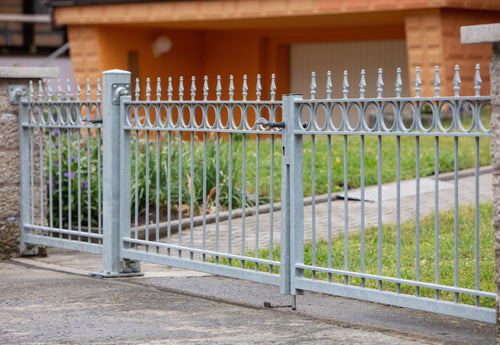
With its clean lines, the Ancona fence from ELEO blends harmoniously into a range of garden layouts.
Powder coating and hot-dip galvanising compared
| Feature | Duplex system at ELEO Express | Hot-dip galvanising |
|---|---|---|
| Coating structure | KTL e-coating as the base layer and powder coating as the topcoat | Zinc coating as an independent coating option |
| Appearance | Even, coloured surface | Characteristic metallic look |
| Colour options | Anthracite or a special colour in any RAL shade | No additional colour topcoat |
Which finish is suitable for a project depends primarily on the desired appearance and the intended coating structure. The system consisting of KTL and powder coating is an option when a defined colour and an even surface are the main priorities. If, on the other hand, the typical metallic appearance of galvanising is to remain visible, hot-dip galvanising may be suitable. The two variants should be distinguished from one another; powder coating does not automatically mean that the metal has previously been hot-dip galvanised.
Frequently asked questions
What is the difference between duplex coating and powder coating?
Powder coating refers to the colour-providing topcoat. A duplex coating, by contrast, consists of two coordinated coatings. At ELEO Express, these are the KTL e-coating as the primer and the powder layer above it. Powder coating is therefore a component of the duplex system, but is not the same as the complete structure.
Is a powder-coated product also hot-dip galvanised?
No, powder coating does not require hot-dip galvanising. At ELEO Express, the duplex process described is based on KTL and powder coating. Hot-dip galvanising is a separate option with a zinc coating and a characteristic metallic surface. Always check the stated coating specification.
How long does a duplex coating last and are special colours possible?
A fixed service life cannot be reliably stated without information on location, weather conditions, use, installation and care. Mechanical damage and local influences can alter the condition of the surface. Regular inspections make it possible to identify signs of damage early. Anthracite and special colours in any RAL shade are available for the colour finish.


