

Key Takeaways
- The choice of material for a garden gate significantly determines stability, maintenance requirements, and lifespan in everyday use.
- While wood impresses with its natural appearance but requires intensive maintenance, aluminium is lightweight but shows weaknesses under heavy loads.
- High-quality steel, protected by hot-dip galvanisation and powder coating, offers the most robust and durable solution, as produced by ELEO.
A garden gate is more than just a functional access point to your property. It shapes the first impression, provides security, and should function reliably for many years. Choosing the right material is the most important decision, as it influences not only the appearance, but above all the stability, durability, and maintenance effort required. Whether a wooden garden gate, an aluminium garden gate, or a metal garden gate is the best choice depends on your individual priorities. This comparison provides a sound basis for decision-making with a realistic look at the pros and cons of each material.

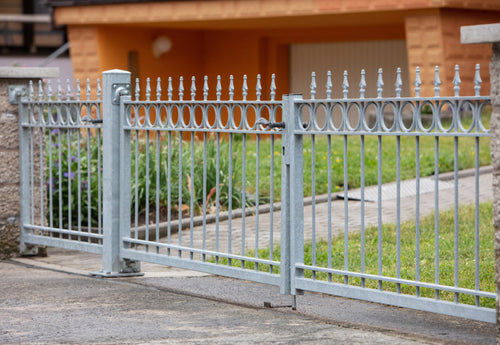
Lugano garden gate with fence: Metal garden gate and fence – the durable and stylish solution for your property access.
Garden gate material – what matters when making your choice
A garden gate is exposed to daily stresses: it is opened and closed, wind forces act on the gate leaves, and weathering such as rain, snow, and UV radiation takes its toll on the material. To ensure that function and appearance remain convincing in the long term, the following criteria are decisive when comparing materials:
- Stability and shape retention: Does the gate leaf retain its shape or is it prone to warping, sagging, or loose fittings?
- Durability and lifespan: How many years or decades will the material last before it loses structural integrity or requires extensive restoration?
- Maintenance effort: Is occasional cleaning sufficient, or are regular protective coats required to maintain its value?
- Weather resistance: How well is the material protected against moisture, UV radiation, and freeze-thaw cycles?
- Corrosion protection: A central topic for metallic materials – how effectively is rust formation prevented?
- Ease of repair: How easily can scratches, dents, or other damage be fixed?
- Design and appearance: What design options does the material offer to blend harmoniously with the architecture and garden design?
- Cost consideration: In addition to the pure purchase price, potential follow-up costs for care and maintenance must also be taken into account.
A decision based purely on personal taste can lead to high effort or disappointment in the long run. It is therefore worth taking a detailed look at the three most common materials.
Discover the perfect garden gate for your garden
Wooden garden gate – pros and cons
Appearance and versatility
A wooden garden gate radiates warmth and naturalness, fitting particularly well into rural or nature-inspired gardens. Wood is a versatile material that can be customized with stains or opaque paints. Wood species such as larch or Douglas fir are naturally more weather-resistant than pine, for example, but still require consistent protection to preserve their beauty and functionality.
An advantage of wood is the relatively easy repair of minor damage. Scratches or peeling paint can often be fixed by sanding and repainting, allowing for continuous maintenance.
Maintenance requirements and weather vulnerability
The biggest challenge with wood is its tendency to "work". As it absorbs and releases moisture, it swells and shrinks. This can lead to warping, cracking, or a jamming lock. Especially with wider gate leaves, dimensional stability is a critical factor, as wind loads constantly strain the material.
A wooden gate requires intact surface protection. In practice, this means that depending on weather exposure, the surface must be sanded down every two to five years and treated with a new stain or protective varnish. If this maintenance is neglected, moisture can penetrate the wood, leading to rot, fungal attack, and an irreparable loss of stability.
Aluminium garden gate – pros and cons
Lightweight with load limits
An aluminium garden gate scores points for its low weight, which facilitates transport and installation. Aluminium is naturally rust-free, making it a low-maintenance option. The surface is often powder-coated or anodised, creating a modern, clean look.
However, the lightweight construction also has disadvantages. Aluminium gates often consist of hollow section profiles, which save weight but exhibit lower flexural rigidity under concentrated loads compared to solid steel. Under strong wind loads or high frequency of use, the structure can reach its limits, resulting in a less solid closing feel or play in the fittings.
Purchase costs and impact sensitivity
High-quality aluminium gates with sturdy profiles and a durable coating are often positioned in the mid-to-high price segment. A major disadvantage is impact sensitivity. The softer material is susceptible to dents and dings – caused, for example, by an impacting ball, a leaning bicycle, or hail. Such damage can hardly be repaired invisibly, as the material yields and the surface remains permanently deformed.
Metal garden gate – the most stable and durable solution
Stability through high-quality steel
When it comes to maximum stability and permanently precise operation, a metal garden gate made from high-quality steel is the superior choice. Steel provides excellent dimensional stability and torsional rigidity. This means the gate leaf maintains its geometry over decades, even under heavy wind loads and intensive use. The result is a solid, secure closing feel and constant alignment without the need for readjustment.
Durability through hot-dip galvanisation and powder coating
The lifespan of a steel gate depends crucially on corrosion protection. The most effective method is a combination of hot-dip galvanisation and powder coating. During hot-dip galvanisation, the entire gate is immersed in a bath of molten zinc at 450 °C. This creates a resistant, metallurgical alloy layer of iron and zinc that protects the steel completely, not just on the surface, but also in all hollow spaces and along the edges. The subsequent powder coating creates a thick, uniform, and elastic protective layer. The colour powder is applied electrostatically and baked at high temperatures. This results in an extremely robust surface that withstands impacts and scratches far better than conventional wet paint, while also being more environmentally friendly.
Low maintenance in everyday life
Thanks to this dual protection system, maintenance for a steel garden gate is minimal. No regular protective painting is needed. For cleaning, water is usually sufficient to remove superficial dirt. This low-maintenance quality makes a metal gate the ideal solution for anyone seeking a permanently attractive and functional gate without recurring maintenance work.

The Lucca garden gate by ELEO creates a stylish entrance to your garden.
Optional convenience: Matching electric drive for your garden gate
For maximum convenience, a robust metal garden gate can be equipped with an electric drive. The Twist Black Edition drive is designed as a matching accessory for ELEO gate systems and is available in two variants depending on the mounting situation on the posts.
| Feature | Twist M | Twist ML |
|---|---|---|
| Suitability per leaf | approx. 2.5 m width and up to 300 kg weight | approx. 2.5 m width and up to 300 kg weight |
| Incline handling | up to 10% | up to 10% |
| Post situation | Gate systems with posts ≤ 200 mm (incl. ELEO posts) | Concrete posts or posts > 200 mm |
| Scope of delivery | Each set includes two hand transmitters (differing from illustration). | Each set includes two hand transmitters (differing from illustration). |
Selection is simple: for gate systems with standard posts up to 200 mm wide, the Twist M is the right choice. For solid concrete posts or posts wider than 200 mm, the Twist ML provides the necessary mounting distance. Both motors are designed to reliably handle the stability and weight of high-quality metal gates.

Avelino courtyard gate with Twist electric drive:
Effortless automation on wide stone posts for maximum convenience.
Comparison of garden gate materials – overview
The following table summarizes the essential properties of the materials and allows for a direct comparison to aid your decision.
| Criterion | Wooden garden gate | Aluminium garden gate | Metal garden gate (Steel) |
|---|---|---|---|
| Stability | Medium; tends to warp ("work") due to moisture | Medium; lower flexural rigidity, prone to deformation | Very high; maximum dimensional stability and torsional rigidity |
| Lifespan | Good, but highly dependent on care | Good, depending on surface finish and construction | Very good; lasts for decades with hot-dip galvanisation and powder coating |
| Maintenance effort | High; regular protective coating required | Low; occasional cleaning | Very low; occasional cleaning as needed is sufficient |
| Weather resistance | Medium; only ensured if protective layer remains intact | Good | Very good thanks to dual surface protection |
| Corrosion protection | Not applicable (requires protection against rot instead) | Very good (inherently rust-proof) | Excellent with hot-dip galvanisation + powder coating |
| Ease of repair | Good; sanding and painting possible | Low; dents and scratches are often irreparable | Good; minor damage can be touched up with repair sets |
| Appearance | Natural, warm, classic | Modern, plain, often technical-looking | Versatile: from classic ornate to modern minimalist |
| Purchase cost | Low to medium; high follow-up costs due to care | Medium to high | Medium to high; pays off over time due to durability |
Conclusion – which material suits your garden gate?
Choosing the ideal material for a garden gate involves weighing aesthetics, functionality, and long-term upkeep:
- Wood is the right choice for lovers of a natural look who are willing to invest time and effort in regular care to protect the material from weather conditions.
- Aluminium is suitable for modern architecture and situations where low weight is crucial. However, compromises must be made regarding robustness and impact resistance.
- Metal (Steel) represents the best solution for anyone who values maximum stability, ultimate durability, and minimal maintenance. A hot-dip galvanised and powder-coated steel gate is a long-term investment that impresses continuously in performance and appearance.
If you don't want to deal with painting, warping, or sticking locks every few years, a high-quality metal garden gate provides the most reliable and ultimately hassle-free alternative.


