Installing balcony railings: DIY or a specialist company – which is the best option

Installing balcony railings: DIY or a specialist company – which is the best option


Key points at a glance

  • A balcony railing is a fall protection system; for secure installation, standards, the building substrate and the fixing system are more decisive than pure craftsmanship.
  • Installing a balcony railing yourself is a realistic option, provided the substrate is load-bearing, measurements are precise and the installation method is clearly defined.
  • Standard-compliant complete kits from ELEO Express reduce the risk of installation errors, as all system components such as posts, handrails and bars are precisely matched.


The decision to install a balcony railing is often driven by aspects such as appearance and cost. Both play a role, but the decisive factor is its function: a railing is a safety-critical fall protection system that must function reliably every day. It must withstand wind loads, resist people leaning against it and endure weather conditions for decades. The question of whether installation should be carried out as a DIY project or by a professional company therefore depends less on manual skill and more on a realistic assessment of the structural conditions, applicable standards and an installation that meets these requirements.

This article serves as a well-founded basis for decision-making. It explains when it makes sense to install a balcony railing yourself, where typical pitfalls lie and when a professional company is ultimately the safer and more cost-effective solution.


Discover balcony railings from ELEORight arrow


Why Installing a Balcony Railing Is More Than a DIY Project

A balcony railing is not a piece of furniture, but a structural component permanently connected to the building with a clearly defined protective function. After installation, it carries significant responsibility: it must safely absorb defined loads, must not deform excessively under stress or come loose, and must be permanently protected against corrosion. These requirements apply to both new builds and the renovation of existing balconies.

In practice, safety and durability depend on details that are often underestimated at first glance:

  • Substrate and load-bearing capacity: Fixing into a solid concrete slab places different demands than installation on porous brickwork or on a façade with an external thermal insulation composite system (ETICS). Each material requires a specific anchoring concept to safely transfer the forces involved.
  • Fixing method and leverage forces: A face-fixed (front-mounted) installation creates different leverage forces on the fixing points than a top-mounted installation on the floor slab. The choice of method has direct implications for structural performance and necessary sealing.
  • Dimensional accuracy and stress: Even a deviation of a few millimetres can result in posts no longer being perfectly vertical. The result is not only an unattractive appearance but also unwanted stresses in the material, which can lead to premature wear.
  • Weather protection: An external component is constantly exposed to moisture, UV radiation and temperature fluctuations. Material choice, surface coating (e.g. hot-dip galvanising and powder coating) and the correct execution of all joints are crucial for a long service life.

Careful planning that takes these points into account is the foundation for successful installation. Starting prematurely without a clear concept carries the risk of a fixing that may initially appear stable but can fail under real load.


Which Standards and Regulations a Balcony Railing Must Meet


Belluno Railing in powder-coated anthracite as an eye-catching feature on the balcony. AI-enhanced © ELEO


The construction of railings is subject to clear building regulations and technical standards. Specific requirements vary depending on the federal state, building type and fall height.

A central aspect is load assumptions: the railing must withstand a defined horizontal load at the handrail (line load) without failure. A visually appealing railing does not necessarily meet these structural requirements. Especially when installing a balcony railing, it becomes clear how important it is to combine theory and practice: the substrate may prove less load-bearing than assumed, or existing waterproofing layers must not be damaged.

For a detailed overview of regional building regulations, it is advisable to consult the applicable rules and guidelines of the respective federal states, where the relevant requirements are summarised. In general, the following applies: a railing must be planned and fixed in such a way that it safely and permanently transfers all expected loads into the building structure without causing consequential damage such as moisture ingress.


What a High-Quality Complete Kit Should Deliver – and What It Simplifies

A common reason for problems when fixing a balcony railing is not a lack of craftsmanship, but an unsuitable combination of individual components. Posts, handrail, infill, connectors and fixing materials must fit together precisely. A well-designed complete kit eliminates this complexity, as all components are developed as a system.

Key features of a high-quality complete kit:

  • Guaranteed precision fit: All connections, drill holes and spacings are designed to fit together without rework. This ensures a stress-free construction.
  • Systematic installation instructions: Clear, logical guidance leads step by step through the process and minimises the risk of sequencing errors.
  • Defined material quality: The materials and surface coatings used are designed for outdoor use and ensure reliable corrosion protection.
  • Standards-compliant design: Components are already dimensioned to meet common structural requirements and regulations.

The greatest advantage of such a system for DIY users installing a balcony railing themselves is predictability. Fewer individual decisions are required and the number of potential sources of error is reduced. ELEO Express relies on standardised, coordinated railing complete kits in common dimensions – a pragmatic approach that makes installation safer and more manageable from the outset.


Our railing kits


Typical DIY Mistakes and How to Avoid Them

Most DIY projects fail not due to the inability to tighten a screw, but due to misjudgements in the planning phase. The following table shows the most common mistakes and how to avoid them.

Typical Mistake Why It Is Critical Solution-Oriented Approach
Incorrect assessment of the substrate Wall plugs or anchors do not hold; the load-bearing capacity of the fixing is not ensured. Check the substrate structure in advance (e.g. by a test drilling). Choose the fixing system (e.g. heavy-duty anchors, injection mortar) to match the material.
Drill holes too close to the edge Concrete or masonry may break out, drastically reducing the holding force of the anchor. Strictly observe the edge and spacing distances specified by the anchor manufacturer. Carefully mark out the drilling pattern.
Damage to the waterproofing layer Moisture ingress leads to frost damage, mould and severe structural damage, which is costly to repair. Plan fixing points so that the waterproofing remains intact. Any penetration must be properly and permanently sealed.
Posts not precisely aligned Uneven load distribution creates stress in the material, which can lead to loosening. The appearance also suffers. Align posts exactly using a string line or construction laser, ensuring they are straight and plumb. Fix temporarily, align, then tighten finally.
Incorrect torque Loose screws may come undone. Overtightened screws can damage the material or the anchor. Tighten screws in a controlled manner using the torque recommended by the manufacturer, ideally with a torque wrench.


What Tools and Prior Knowledge Are Really Required


Lucca Railing in powder-coated anthracite shown in a detailed view with its decorative accents. © ELEO


Professional-grade tools are a fundamental requirement for correctly fixing a balcony railing. What matters is not the number of tools, but their quality and suitability for the task.

Essential Tools

  • Powerful rotary hammer (e.g. with SDS chuck for concrete) or hammer drill
  • High-quality drill bits suitable for the substrate in the correct diameters
  • Precise measuring tools: tape measure, square, laser distance meter
  • Long spirit level or construction laser for accurate alignment
  • Solid ratchet kit with suitable sockets and, if necessary, a torque wrench
  • Tools for cleaning out drill holes (important for chemical anchors)

Required Prior Knowledge

  • Ability to identify building substrates and apply the correct drilling technique
  • Understanding of construction plans and dimension chains for transfer to the site
  • Planning skills to structure installation processes logically
  • Basic knowledge of proper sealing of joints in outdoor areas
  • An eye for quality control: checking alignment, plumb and secure fixing of all connections


DIY or Professional Company: An Honest Comparison of Pros and Cons

The decision between DIY installation and hiring a professional company involves weighing costs, time, risk and the desired quality standard. The following table compares the key aspects:

Aspect Install Balcony Railing Yourself Installation by Professional Company
Control & Flexibility Full control over schedule and execution details. Clear, professional processes, but less flexibility for spontaneous changes.
Risk Profile Full responsibility for installation errors, substrate assessment and sealing lies with the client. The company is liable for proper execution and provides warranty.
Time Required The overall effort for planning, material procurement, installation and error correction is often underestimated. The installation timeframe is clearly defined and usually significantly shorter.
Costs Savings on installation costs, but risk of additional costs due to errors or material wear. Higher initial investment, but predictable total costs without unexpected expenses.
Quality of Results A perfect result is possible if planning, system and execution are optimally aligned. Consistently high quality ensured by experience and professional tools.


When a Professional Company Is the Safer and More Cost-Effective Choice

In certain scenarios, hiring a professional company is not just a matter of convenience, but a rational necessity to avoid costly consequential damage and safety risks.

  • Critical substrate: For old concrete balconies with unclear reinforcement, porous masonry or renovation projects, professional assessment is essential.
  • Demanding waterproofing: If railing posts must penetrate the balcony waterproofing layer, proper sealing is crucial to prevent moisture damage.
  • Complex geometry: Corner balconies, curved projections, sloping slabs or connections to different façade materials require experience and often custom solutions.
  • High fall height: As height increases, so do safety requirements and wind loads, requiring absolutely flawless installation.
  • External thermal insulation composite system (ETICS): Fixing through thick insulation layers requires special systems to avoid thermal bridges and ensure stable anchoring in the masonry.

From an economic perspective, a professional company often becomes the better choice when the “hidden costs” of DIY are honestly considered: time spent researching, additional trips to DIY stores, costs of incorrect purchases and the financial risk of structural damage.


What to Consider When Buying a Balcony Railing Before Installation


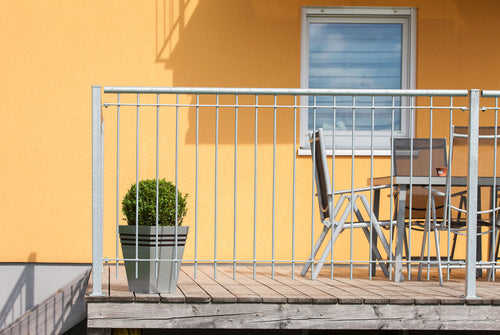
Ancona Railing in hot-dip galvanised finish, installed on a raised terrace with a wooden substrate. © ELEO


A successful installation begins long before the first drill hole – namely with the right product selection. A decision that is not aligned with the structural conditions inevitably leads to compromises and improvisation during fixing.

The Foundation of Installation: Precise Measurement

Accurate measurement captures not only the pure lengths. It defines the exact positions of the posts, taking into account the required edge distances from the concrete and load distribution. Even slight unevenness or angular deviations in existing structures must be recorded in order to respond appropriately during installation.

Installation Method and Substrate: An Inseparable Unit

The decision between face-fixed and top-mounted installation should be based on the balcony structure. Does the chosen fixing system match the substrate? Can the waterproofing layer be taken into account? These questions must be clarified before ordering, not on site.

System Instead of Patchwork: Reducing Complexity

A complete kit is a strategy for minimising risk. Fewer interfaces between different manufacturers mean a clear installation sequence and compatible components. This allows full focus on the critical steps of alignment and fixing, rather than trying to adapt individual parts.


Frequently Asked Questions

Can a balcony railing be installed without professional craftsmanship experience?

Yes, this is possible if the conditions are right. A clear installation situation with a load-bearing, easily accessible substrate, the use of a high-quality complete kit and a precise, methodical approach are essential. The project should be understood as a safety-critical construction task with a focus on care, not as a quick fixing job.

When does fixing a balcony railing become technically critical?

It becomes critical whenever there is uncertainty regarding the substrate (e.g. in renovation projects), when the waterproofing layer must be penetrated or when fixing points are very close to component edges. Complex geometries or installation on insulated façades also require specialised expertise and are risky for non-professionals.

What specific advantage does a complete kit offer during installation?

A good complete kit eliminates issues with component compatibility. Posts, handrails, infills and connectors are coordinated. This ensures a logical, predictable installation, minimises improvisation and saves significant time during preparation and execution. The result is a coherent and stable construction.


Conclusion: Make an Informed Decision – for Greater Safety and a Cohesive Result

Whether installing a balcony railing yourself or hiring a professional company should be a conscious decision based on technical requirements, the condition of the substrate and a realistic self-assessment. DIY is an excellent option for careful planners with practical understanding who rely on a well-designed system railing. A professional company, on the other hand, is always the wiser choice when structural conditions are complex or when maximum safety and warranty are the priority.

Start your installation well prepared:
Our balcony railing complete kits include all coordinated system components, are manufactured in accordance with standards and are available directly in standard dimensions – the ideal basis for secure fixing.


Discover our complete balcony railing kits nowRight arrow


Tip

Guide tip: Here’s how to ensure your balcony railing meets all the requirements:
» Read our guide ‘Regulations for balcony railings in your state’ now!

Back to Blog
We are here for you!

Monday to Friday: 8 a.m. - 6 p.m.

Contact form
customerservice@eleo-express.co.uk