Plug-in fence in the garden – advantages, possible uses and limitations
Key Highlights
- A plug-in fence allows for quick and reversible garden structuring, ideal for bordering flower beds, paths or securing pond edges without extensive construction work.
- A metal plug-in fence impresses with its dimensional stability, weather resistance and high-quality appearance. ELEO Express relies on durable materials for long-lasting, attractive garden design.
- For high security requirements, permanent boundary fencing or keeping pets prone to jumping, fixed fence systems are often the superior choice.
A garden is a living space that is constantly changing: a new perennial bed is created, the vegetable patch is extended, or a pond becomes the new focal point. For such dynamic requirements, the plug-in fence is proving to be an increasingly popular solution. It can be set up quickly, moved as needed and creates clear structures without the need for pouring foundations or using heavy machinery. Nevertheless, a realistic perspective is crucial: a plug-in fence is a versatile helper, but not a "jack of all trades". Knowing its strengths and weaknesses allows for an informed decision and avoids poor investments.
Intro – Why plug-in fences are becoming increasingly popular in the garden
Modular plug-in systems correspond to the modern understanding of garden design, which is characterised by flexibility and gradual development. Instead of establishing a rigid, final fence line, they make it possible to test out areas and react to changes. Where is the ideal route for the new garden path? Which boundary best protects the young roses from the dog at play? How does a seating area look when it is visually framed? Especially in newly landscaped gardens, rental properties or during phases of redesign, the plug-in fence demonstrates its full range of advantages.
The aesthetic value is also not to be underestimated. A clean line separates the kitchen garden from the ornamental garden, elegantly encloses a terrace or ensures a calmer overall appearance at the pond's edge. The key to success lies in tailoring the construction precisely to the task at hand – especially when animals, challenging soil conditions or wind-exposed locations must be considered.
What is a plug-in fence and how does the system work?
By definition, a plug-in fence is a fencing system that functions without traditional foundation work.
The stability of plug-in fences is achieved through posts with integrated ground spikes, which are driven or pressed directly into the soil. The actual fence panels are then hung, slotted or screwed into these firmly anchored posts. The basic principle is designed for simple, fast and, above all, reversible assembly. It allows the fence to be extended, realigned or completely removed at any time.
The central components of a plug-in fence
The interaction of individual components is crucial for a stable and visually convincing solution:
- Plug-in posts with ground spikes: They are the backbone of the construction. Their length and material thickness largely determine stability. The deeper the spike is anchored in firm ground, the more lateral force the fence can withstand.
- Fence elements: These define the look and function. The selection ranges from simple bars and mesh panels to decorative panels. Their materiality and construction influence stability and the degree of transparency.
- Connectors: Depending on the system, clips, screws or special hooks ensure that the fence panels sit securely in the posts and do not rattle or unhook under load.
Careful alignment of the first post is vital, as small inaccuracies accumulate over the entire length of the fence. Using a spirit level and a chalk line here will be rewarded with a straight and professional-looking fence line.
Metal plug-in fences – advantages over other materials
Powder-coated - Uncoated - Hot-dip galvanised
For use in the garden, a metal plug-in fence represents a particularly durable and value-retaining solution. While wood reacts to moisture, can warp and requires regular protective coatings, and plastic often loses colour and flexibility under strong UV radiation, metal scores points through its outstanding dimensional stability and weather resistance.
Why metal is the superior choice for plug-in systems
- Excellent dimensional stability: Metal retains its shape and line, does not warp with temperature fluctuations and ensures a straight, clean look even with longer fence panels.
- Superb weatherproofing: Processes such as hot-dip galvanising and subsequent powder coating create a robust protective layer that reliably protects steel from corrosion, UV radiation and scratches.
- Minimal maintenance: A metal fence does not need to be painted or treated. Cleaning with water and a mild detergent is usually perfectly sufficient.
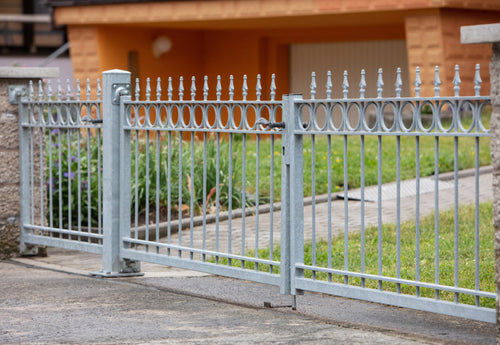
- Timeless aesthetics: Metal fences, such as those from ELEO Express, blend harmoniously into gardens with their often delicate design. They appear less massive than closed walls and allow an unobstructed view of plants and structures.
Anyone viewing a plug-in fence not just as a temporary fix, but as a permanent design element, will find metal to be the best choice. It combines the flexibility of the system with the robustness and high-quality appearance of a fixed fence.
Our plug-in fences
The benefits of a plug-in fence in the garden
The primary benefit of a plug-in fence lies in its ability to "direct" and organise the garden without partitioning it permanently. It is the ideal solution for garden owners who prefer a step-by-step development rather than making far-reaching decisions immediately.
Practical advantages
- Assembly without concrete or heavy earthworks
- Easy to move if garden usage changes
- Modular expandability for growing projects
- Easy accessibility for maintenance work on flower beds
Design advantages
- Creation of clear lines and visual calm
- Harmonious combination with hedges and perennials
- Elegant framing of seating areas and terraces
- Definition of garden rooms without massive barriers
Another decisive plus point is scalability. You might start with a short border for the herb bed. Next year, the fence is extended to hide the new compost area. In this way, the system grows with your needs without the garden looking like a patchwork quilt.
Possible applications – bordering the garden, terrace and pond
A plug-in fence is far more than just a decorative element. Correctly planned and placed, it solves everyday challenges in the garden: it directs movement, protects sensitive areas and creates a sensible separation between functional and relaxation spaces.
Plug-in fence at the pond: safety and aesthetics
A pond plug-in fence primarily serves to visually mark the bank zone and create a respectful distance. Especially in gardens where children play, or to prevent guests from accidentally stepping into the water at dusk, a low but visible boundary ensures safety. Furthermore, the fence facilitates pond edge maintenance, as it forms a clear line against the lawn and inhibits grass from growing into the bank zone.
Designing the terrace and seating area as a "garden room"
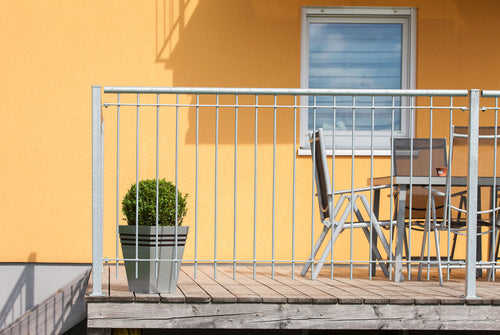
Large, open terraces can feel uninviting. A low-profile plug-in fence can serve as a design element here, visually enclosing the seating area and giving it the character of a sheltered "garden room". A metal plug-in fence appears particularly airy and elegant, defining the space without completely blocking the view of the rest of the garden.
Structuring beds, paths and utility areas
Whether it's the vegetable patch, compost corner or the bin storage area: a plug-in fence clearly separates these functional zones from the rest of the garden. This is ideal for observing and adjusting usage throughout the seasons. Additionally, the fence serves practical purposes by helping to keep bark mulch, gravel or loose soil within the beds and preventing wash-out during heavy rain.
Plug-in fences for dogs and other animals – what matters
A dog plug-in fence or a boundary for other pets is a common use case. The aim is to protect certain areas, keep animals away from sensitive plants or channel walking paths. Here, the distinction between a "visual barrier" and an "escape-proof enclosure" is of central importance.
Plug-in fence for animals: assessing requirements correctly
When used as a plug-in fence for animals, several factors must be evaluated. The temperament and size of the animal are just as important as the height and stability of the fence. For a calm, small dog, a visual boundary may suffice. For an agile or strong dog that jumps against or pushes the fence, the requirements for anchoring, material thickness and bar spacing increase significantly.
- Adapted height: A Dachshund has different requirements than a Labrador. The height must be chosen so that the animal cannot easily jump over it.
- Small bar spacing: To ensure the head cannot be pushed through and to avoid risk of injury, narrow gaps are important.
- Stable anchoring: If pressure loads are expected, longer ground spikes and possibly shorter post distances are necessary for better force distribution.
- Protection against digging: For dogs with a digging instinct, a ground-level edge or a separate mesh recessed into the ground may be useful.
For a temporarily partitioned puppy run or to prevent the dog from entering freshly planted beds, a plug-in fence is often the perfect, flexible solution. However, if the fence is intended to serve as the sole, permanent and secure enclosure for the entire property, a fixed, foundation-based fence is usually the more reliable choice.
Stability and height – what a plug-in fence can achieve
Plug-in fence Balerna - powder-coated anthracite.
The stability of a plug-in fence is determined not just by the system itself, but by the interaction of several factors: material quality, post spacing, anchoring depth, soil conditions and the expected wind load. A well-planned metal plug-in fence can exhibit considerable stability. Nevertheless, under extreme loads, it generally does not reach the level of a system set in concrete.
Factors affecting stability
| Factor | Impact in practice | Practical tip |
|---|---|---|
| Soil conditions | Sandy, loose soil offers ground spikes less grip than firm clay soil. | In loose soil, choose longer ground spikes or reduce the post spacing. |
| Wind load | Large, closed elements catch a lot of wind and increase the load on the posts. | In wind-exposed locations, prefer airier bar or mesh designs. |
| Fence height | As height increases, the leverage effect on the ground anchoring grows exponentially. | Keep the height to the necessary minimum and ensure appropriately dimensioned posts. |
| Material and construction | Solid metal is more torsion-resistant than thin wires or flexible plastics. | For permanent stability and a straight line, a metal plug-in fence is the best choice. |
Generally, a low plug-in fence up to approx. 80 cm in height is easy to anchor in most soils. Once the height exceeds one metre, soil conditions and wind load must be checked particularly carefully. The most honest approach is therefore to define the purpose first and derive the necessary height from that – not vice versa.
Limits of the plug-in fence – when other fencing solutions make more sense
The strength of the plug-in fence is its flexibility. It reaches its limits where high mechanical forces act permanently or where normative safety requirements must be met. In the following scenarios, a classic, fixed-foundation fence is often the better alternative:
- Permanent property boundary with security function: If the fence is to serve as a deterrent against intruders or to fulfill insurance requirements, concrete-set posts are indispensable.
- Highly wind-exposed locations: On coasts or open fields, extreme wind forces can occur that require deeper and more massive anchoring.
- Steep slopes or hillsides: On steep terrain, the lateral thrust forces on the posts are very high. Foundation-based steps or special slope posts are necessary here.
- Keeping large, high-jumping animals: An escape-proof area for large dogs or other animals requires a height and stability that a plug-in system usually cannot guarantee.
- Compliance with building regulations: Above a certain height (often 1.80 m) or for fences on the property line, local building codes may require a foundation.
This does not diminish the value of plug-in fences; it simply clarifies their optimal area of use. Choosing the right solution for the respective task ensures long-term satisfaction with the result.
Tip: Plug-in fence or classic fence – choosing the right solution
The decision can be simplified by answering three core questions: 1. How permanent is the planned boundary? 2. How high is the expected load (wind, animals, leaning)? 3. How important is the possibility of a later change?
- A plug-in fence is the first choice for flexible garden planning, temporary barriers, visual marking of pond edges, seasonal protection measures and creating structure without construction effort.
- A metal plug-in fence is the premium variant when the flexible boundary should not only be functional but also durable, low-maintenance and visually high-quality.
- A classic fence with foundations is essential for permanent boundary fencing, high fences, heavy loads from animals or when maximum stability and security are priorities.
Frequently Asked Questions
Is a metal plug-in fence suitable for permanent use in the garden?
Yes, absolutely. A high-quality metal plug-in fence is designed for permanent use. Thanks to materials such as hot-dip galvanised and powder-coated steel, it is extremely weather-resistant and retains its shape and colour for many years. The keys to longevity are material quality and anchoring adapted to the soil and fence height.
How useful is a plug-in fence at the pond when children are in the garden?
A pond plug-in fence is a very sensible measure to create a clear visual barrier and prevent unintentional entry into the bank zone. It serves as a guide and increases everyday safety. However, it does not replace the duty of continuous supervision and is generally not a norm-tested fall protection. For toddlers, a higher, more stable and gapless solution should be considered.
Is a plug-in fence sufficient for dogs or is a fixed fence needed?
This depends heavily on the dog and the purpose. A dog plug-in fence is excellent for cordoning off a puppy area, keeping the dog away from flower beds or as a training aid. For a very agile, large or escape-prone dog, a permanent, escape-proof boundary of the property with a fixed fence is the safer and more reliable option.
Conclusion – When a plug-in fence is the right garden solution
A plug-in fence is the ideal choice for garden owners who value flexibility, easy assembly and reversible design. Whether for partitioning zones, securing pond areas or directing pets – it offers a fast and effective solution without permanently altering the property's construction. In particular, the metal plug-in fence combines this adaptability with impressive durability, minimal maintenance and a timelessly elegant look that enhances any garden.
The system finds its limits where permanent high loads, significant fence heights or uncompromising safety requirements are paramount. An honest analysis of your own needs leads to the best decision – for a garden solution that proves its worth in everyday life and can grow with your plans.
Discover our metal plug-in fences – versatile for the garden, animal areas or for the safe bordering of ponds.
Share article


